
Harmonic Mitigation Capacitor Ratings: Voltage, kvar, and THD
2026-11-04 17:33:59
A harmonic mitigation capacitor rating has three parts that work together. The voltage rating must cover system voltage, harmonic voltage, switching transients, and any voltage rise from a detuned reactor. The kvar rating states the reactive power the unit supplies at a set voltage and frequency, and it changes with the square of the applied voltage. THD data shows how much distortion the capacitor and the system can tolerate. I wrote this guide for engineers and purchasing teams at filter device makers and power supply equipment plants, so you can compare designs and write clear specifications.

What a Harmonic Mitigation Capacitor Does in Power Systems
Definition and Core Function
To raise the power factor, a harmonic mitigation capacitor provides leading reactive power, and its design can handle the extra stress that distorted waveforms cause. A detuned reactor, safety fuses, discharge resistors, and a power factor device are often used with it by engineers. That's not what the capacitor does on its own. The reactor lowers the branch's tuned frequency below the lowest harmonic that matters. At that harmonic, the branch acts as an inductance, which keeps it from resonating in parallel with the source. In the case of a 60 Hz system, a 7% reactor sets the branch to about 227 Hz, which is below the 5th harmonic at 300 Hz. The capacitor doesn't get stronger when loads close by send out harmonic currents because of the space between them.
Loads That Create the Need
Different types of drives, rectifiers, welders, UPS systems, and converters all use pulses of electricity instead of smooth sine waves to move current. Harmonic currents are made by those waves. Since a capacitor's impedance goes down as the frequency goes up, it tends to attract them. Electric railroad power substations and electrolytic aluminum rectifier plants can make a lot of harmonics. This is why they have single phase capacitors in their filter branches. IEEE 519-2022 sets harmonic limits at the point of common connection in the United States, and a lot of companies use it. It is safer to use a harmonic mitigation capacitor or a harmonic study than a regular capacitor if any of these sources are in your load profile.
Comparison with Other Power-Quality Solutions
A capacitor bank that is out of tune mostly fixes the power factor and lowers the risk of harmonic amplification. Engineers tune each branch to be close to a certain harmonic order, like the 5th or 7th, so it can absorb that current. This is what a passive harmonic filter does. An active harmonic filter adds current that goes against the load and moves with it over a wide range of frequencies. A harmonic mitigation capacitor is added inside the first two choices instead of being swapped out for new ones. Normal capacitors can still handle straight loads with little distortion. Which one to choose depends on the harmonic spectrum, the target THD, the kvar demand, the voltage level, the space available, the budget, and the ability to maintain the system. I think you should measure first, since a measured range takes away most of the guessing.
Harmonic Mitigation Capacitor Ratings Explained: Voltage, kvar, and THD
Voltage Rating Comes First
Check the voltage first, as it affects all other ratings. A harmonic mitigation capacitor needs to be able to handle the nominal voltage, the utility tolerance, the harmonic voltage, the switching transients, and the rise that a series reactor causes. If you have a detuning reactor with a ratio of p, the voltage of the capacitor is equal to the voltage of the system divided by (1 - p), where p is the reactor ratio in decimal form. It goes up about 7.5% with a 7% reactor and 16.3% with a 14% reactor. It gets too hot, experiences dielectric stress, and lasts less long if the rating is too low. When the rating is too high, it changes the kvar output and adds cost and size. Get information on the rated voltage, insulation level, overvoltage capability, tan ε, and partial discharge. Then, compare the range to the highest voltage you expect to see it working at.
kvar Rating and Sizing
A harmonic reduction capacitor's kvar value tells you how much reactive power it has at a certain voltage and frequency. The output goes up or down with the square of the voltage because Q = 2πfCV². The power goes up or down by about 10% for every 5% change in the voltage. Use measured kW, the current power factor, and the target power factor to figure out the size of a bank. kW times (tan φ1 - tan φ2) is what you need for kvar. A 1,000 kW load that needs to go from a PF of 0.80 to a PF of 0.95 needs around 421 kvar. You shouldn't just rely on motor nameplates; you should also check the minimum load, transformer loading, and harmonic current. Make it clear if a kvar value is given per unit, per step, or per full bank.
THD and Harmonic Performance
For voltage and current, THDv and THDi compare the harmonic content to the fundamental component. Harmonic currents make the RMS current, temperature, and dielectric stress in a capacitor go up. It's better to have low dielectric loss because tan µ causes internal warmth when there is harmonic current. From 1 kV to 69 kV, IEEE 519-2022 says that voltage THD can't be more than 5%, and it can't be more than 3% for any single harmonic. A harmonic mitigation capacitor needs to have its thermal and loss data, as well as its documented ability to handle harmonic current. I don't think you should take any promises of a THD reduction percentage before measuring the site. This is because the results depend on the load spectrum, source impedance, and reactor tuning. First, check that the capacitor current stays within its stated limit. Then, measure THD at typical load levels.
How the Three Ratings Work Together
Don't treat voltage, kvar, and THD as three separate systems. Instead, treat them as one system. When the reactor ratio goes up, the voltage of the capacitor goes up, and the net reactive output changes. When kvar goes up, capacitance goes up, too. This changes the tuned frequency if the reactor doesn't change too. Dielectric stress is raised by harmonic voltage, and the amount of harmonic current carried by the capacitor is controlled by reactor tuning. Compare the rated voltage, kvar basis, harmonic-duty capability, tuned frequency, thermal data, and expected service life of a design all at once before giving it the green light. One rating check might miss some differences, like a unit with enough kvar but not enough voltage margin under a 14% reactor. This way finds those.
How to Select, Specify, and Install a Harmonic Mitigation Capacitor
Application Data to Gather
Application records are the first part of a decision. Get information about the voltage, frequency, phase arrangement, transformer capacity, load type, operating hours, ambient temperature, and location of the installation. Include the measured kW, power factor, and harmonic spectrum, along with the orders that are most powerful. Not only should you write down the harmonic orders you want to filter, but also the duty cycle and any shock or vibration for electrified railroad and electrolytic aluminum work. Then make sure it works with the cooling, reactors, controls, contactors, fuses, breakers, wires, and fuses. Sample production and type testing often take two to four months for first-time projects, so sharing this information early cuts down on the review time. When judging a supplier, you should look at their technical support, paperwork, ability to do custom designs, wait time, batch consistency, warranty, and total cost per kvar.
Technical Data and Documentation to Request
Here are the core items I suggest every purchasing team request before approving a harmonic mitigation capacitor quotation.
- Electrical datasheet: Ask for rated voltage, frequency, kvar, capacitance and tolerance, connection details, dimensions, and temperature category. Add the insulation level, discharge information, internal fuse arrangement, and the stated limit for permissible RMS current, so your engineers can check the unit against their own sizing calculations and the site operating conditions.
- Harmonic and dielectric data: Request harmonic-current withstand, THDv and THDi limits, heat-loss data, tan δ values, partial discharge level, and expected service life. Ask which test conditions produced each number, because a value without a test basis cannot support a fair technical comparison between suppliers or even between two quoted designs.
- Compliance and traceability: Request routine and type-test reports, factory inspection records, quality certificates, and batch traceability. Confirm which standards apply to your voltage class and project specification, such as IEEE 18 or IEC 60871-1 for high voltage shunt capacitors, and ask for installation manuals, commissioning guidance, warranty terms, and spare-part information.
These documents turn a price comparison into a technical comparison, and they reduce the chance of rework after delivery.
Installation, Commissioning, and Common Mistakes
Check the voltage, frequency, phase sequence, grounding, and safety settings of a harmonic reduction capacitor bank before turning it on. Keep track of the power factor, kvar, THDv, THDi, and dominant harmonic orders. Allow air flow and space around the equipment, and make sure to use capacitor-duty contactors with wires and fuses that are rated properly. Check the reactor temperature, phase balance, noise, switching behavior, and capacitor current while it is being put into service. Write down the data for future reference in maintenance documents. People often make mistakes like figuring out kvar based only on motor nameplates, using standard capacitors in high-THD systems, not paying attention to the adjusted frequency, and comparing rates that are based on different assumptions. It may cost more in the long run if the service life, documentation, or technical support aren't good enough for a low price. Look at different quotes based on the stated voltage, the kvar basis, the harmonic conditions, the reactor tuning, the standards, and the warranty.
Xi'an Xikai Harmonic Mitigation Capacitor Solutions
Design Features of the High Voltage Single Phase Filter Capacitor
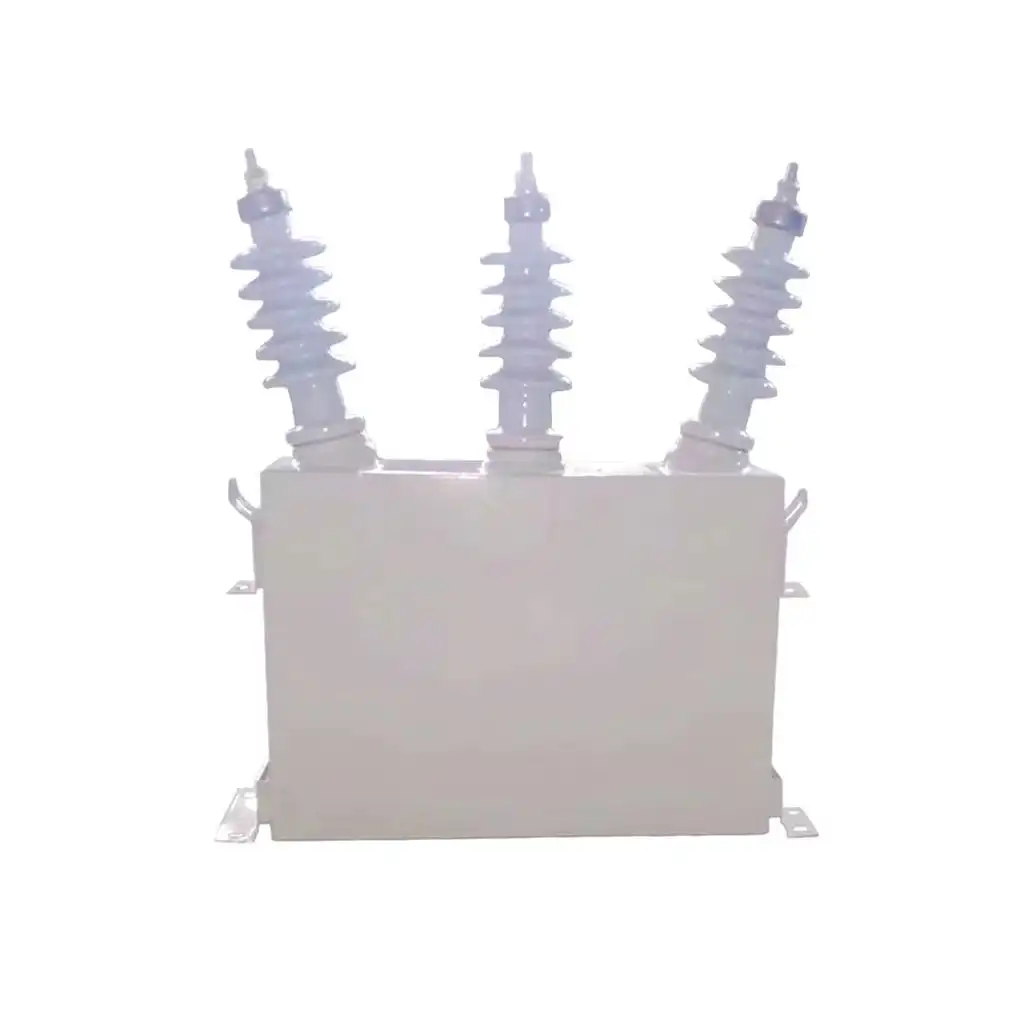
Our High Voltage Single Phase Filter Capacitor works as the single phase building block for a harmonic mitigation capacitor bank or a passive filter branch. Here are its main design features.
- Protection and discharge: Discharge resistors remove residual voltage after de-energizing, and internal fuses use internationally advanced technology to isolate a faulty section so the unit keeps operating. We also improved the connection method of the discharge resistance, which solved the over-voltage problem of the series section, and that change supports stable operation.
- Sealed tank construction: The tanks use new bushings and automatic argon arc welding, so the design stays leak-free. A sealed tank matters in outdoor substations, where temperature swings and weather test every seal, and where a leak would force an outage for inspection and repair. Automatic welding also keeps weld quality consistent.
- Film and electrical performance: Multi-layer polypropylene film with a zinc-aluminum alloy coating allows rapid self-recovery when the dielectric comes under stress. The unit offers low noise and strong overload ability, and its electrical properties have reached an internationally advanced level. The modular design also allows easy integration into existing systems for retrofit projects.
Together, these features address leakage, residual voltage, and internal fault concerns in high voltage filter duty.
Applications in Industry, Substations, and Rail
Different types of tasks can be done with our High Voltage Single Phase Filter Capacitor. It helps fix the power factor for CNC machines and assembly lines in factories. It helps keep the voltage stable in substations by blocking harmonics and the irregular output of green generators. Electrified railroad traction substations and electrolytic aluminum plants often use single phase capacitors to build passive filter branches. To start a harmonic mitigation capacitor project, you should send the harmonic orders you want to filter along with your dielectric loss and partial discharge expectations. State Grid systems, train transportation, steel and metallurgy, petrochemicals, and renewable energy all use Xi'an Xikai goods in large amounts. Also, let us know how high the site is; our plateau-type equipment can work at elevations of up to 4,000 meters, and we check each request against the conditions of the site.
Manufacturing, Testing, and Custom Support
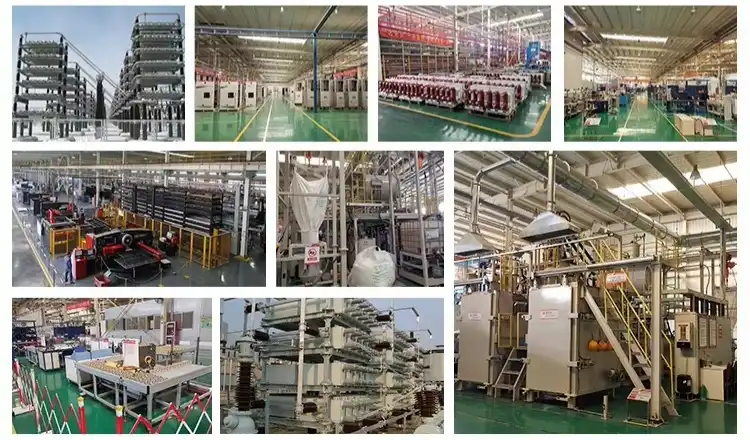
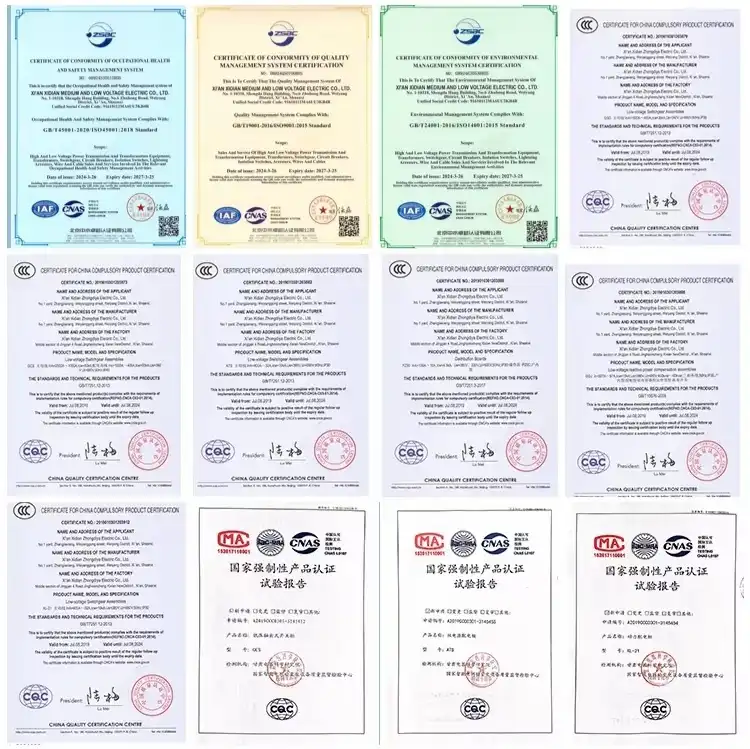
Before we start making things, we check the raw materials with ISO 9001-certified machinery. After that, each unit is put through 72 hours of load cycling, thermal shock tests, and impulse voltage tests. Xi'an Xikai is certified by both ISO 9001 and ISO 14001, and we can change the capacitance, terminals, or cooling mechanisms to fit your design. Our product line includes switchgear, dry-type transformers, power electronics, and more than 100 different types across 7 categories, 34 series, and over 100 versions. This means that the capacitor and all the equipment around it can be supported by the same provider. If a buyer needs prototypes, they should set aside time for type testing and include the voltage margin, tan ε, and partial discharge goals in their first email. This detail helps our engineers make sure the design is possible before making a sample, and it also makes sure that later special orders are the same as the design that was accepted.
Conclusion
There are three ratings that a harmonic mitigation capacitor needs to meet. The voltage has to cover normal, harmonic, transient, and stress caused by the reactor. A 7% or 14% reactor raises the voltage of the capacitor by about 7.5% or 16.3%. The kvar rating changes with the square of the voltage and should be based on targets for kW and power factor. IEEE 519-2022 sets limits at the point of common coupling, and THD data shows how much harmonic current and heat the unit can handle. The three ratings are linked by reactor tuning, thermal data, and measurements taken at the site. It is fair to compare suppliers when there are clear datasheets, test reports, and consistent assumptions made in quotations. This article talks about a single phase filter capacitor that has internal fuses, discharge resistors, and soldered tanks to meet the needs of filter duty.
FAQ
1. Why does a detuned system need a higher capacitor voltage rating?
A series reactor raises the voltage across the capacitor by a factor of 1/(1 − p), where p is the reactor ratio. A 7% reactor adds about 7.5%. Harmonic voltage adds more stress, so the unit needs margin to protect the dielectric.
2. Can a harmonic mitigation capacitor reduce THD by itself?
No. The capacitor supplies reactive power. Reactor tuning or a passive filter design controls the harmonic current path, and site measurements confirm the result.
3. How does kvar change when voltage changes?
Output follows the square of voltage. A 5% voltage rise lifts output by about 10%, and a 5% drop lowers it by about 10%. Always check the voltage basis of a quoted kvar value.
4. What should I send for a rating review?
Send system voltage, frequency, phase arrangement, transformer capacity, load type, power factor, target kvar, and measured THDi or THDv. Add dominant harmonic orders and site altitude.
Request a Harmonic Mitigation Capacitor Quote from Xi'an Xikai
Xi'an Xikai makes harmonic mitigation capacitors. They have 7 product categories, 34 series, and equipment that is flat and meets requirements up to 4,000 meters. As serina@xaxd-electric.com, amber@xaxd-electric.com, or luna@xaxd-electric.com, you can send your system voltage, frequency, kvar target, and measured THD. Our engineers will look over your needs for a harmonic reduction capacitor and talk about making a unique design. For more information, go to xaxd-electric.com.
References
1. IEEE Std 519-2022, IEEE Standard for Harmonic Control in Electric Power Systems, 2022
2. IEEE Std 18-2012, IEEE Standard for Shunt Power Capacitors, 2012
3. IEEE Std 1036-2020, IEEE Guide for the Application of Shunt Power Capacitors, 2020
4. IEC 60871-1, Shunt Capacitors for A.C. Power Systems Having a Rated Voltage Above 1000 V, Part 1: General, 2014
5. Power System Harmonics and Passive Filter Designs (Wiley-IEEE Press), 2015
6. Electrical Power Systems Quality (McGraw-Hill), 2012