
Indoor Vacuum Circuit Breaker: Mechanical Endurance and Reliability
2026-11-19 17:20:10
There are three things that make an indoor vacuum circuit breaker reliable: a sealed vacuum interrupter that keeps its vacuum, an operating mechanism that works smoothly after thousands of operations, and a breaker body that fits the switchgear around it. Mechanical endurance is the number of times a mechanism can open and close before wear changes its timing or travel. When it comes to building switchgear, that number is just as important as breaking current. This is because a panel can be stopped just as quickly by a weak interrupter or a sticky racking mechanism. I'll show you how to judge both below.
What Is an Indoor Vacuum Circuit Breaker, and How Does It Work?
How the Vacuum Interrupter Clears a Fault
A medium-voltage vacuum breaker opens its contacts inside a chamber made of glass or ceramic that is sealed. There is a short metal-vapor arc when the contacts break apart. When the natural current hits zero for the first time, the arc ends. Within microseconds, the vacuum returns to its dielectric strength. There is no need to fill up the interrupter because it doesn't hold any gas or oil. Because of how it's made, the indoor vacuum circuit breaker is often used to protect 12 kV systems' transformers, motors, feeders, and generators. Before they choose a model, buyers still need to make sure of the rated voltage, rated current, insulation level, and short-circuit breaking current, which could be 31.5 kA or 40 kA.
Main Components and Their Jobs
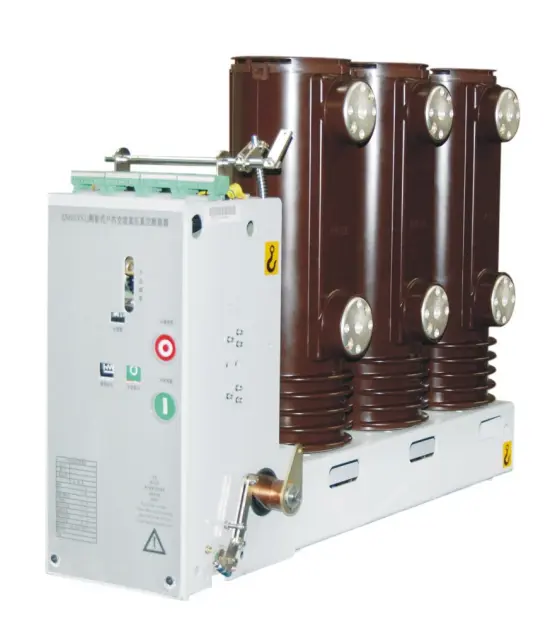
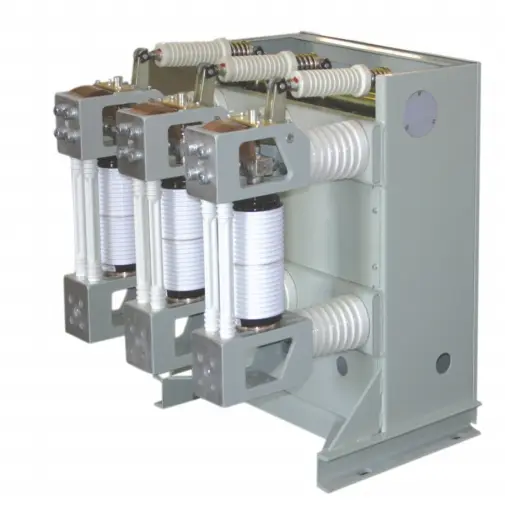
There are four groups of parts that decide how the breaker works. The contacts, arc shield, and bellows are all held in place by the vacuum interrupter. It stores energy in a spring, pushes the contacts shut, and holds them in place with latches. Local and remote control are handled by the trip and closing coils, the charging motor, and the extra contacts. The breaker is linked to the cabinet by the frame, the insulating poles, and the 2nd plug. As important as the interrupter is, the interlocks, grounding contacts, and shutter alignment are also important for the retractable version that has a truck and racking system added to it. If even one of the groups goes out of tolerance, the whole breaker breaks, so I ask suppliers to list all four.
Mechanical Endurance Versus Electrical Endurance
Both of these words sound the same, but they mean different things. Open-and-close operations with no load count as mechanical endurance. Based on IEC 62271-100, class M1 has 2,000 operations and class M2 has 10,000 operations. Electrical endurance is the number of times the breaker stops load or fault current before the contacts need to be serviced. If the class is E2, it means that the parts that stop the current won't need any maintenance for the expected life. If the feeder only changes places a few times a year, it needs different things than a motor feeder or an automatic transfer scheme that works every day. When you size an indoor vacuum circuit breaker, make sure that both ratings match the real duty and that the mechanism can handle 10,000 or 30,000 operations.
What Determines Indoor Vacuum Circuit Breaker Reliability?
Vacuum Integrity and Vacuum Decay
Large amounts of vacuum loss worry a lot of engineers. An interrupter that is well-made will last for decades because the envelope, metal seals, and bellows are brazed together under vacuum. A bad seal, broken bellows, or repeated mechanical shocks are often to blame when vacuum does break down. Since you can't see vacuum, you have to test for it. A power-frequency withstand test across the open contacts checks to see if the gap is still there and if it breaks at the right voltage points due to lost vacuum. You should ask your supplier how it checks each interrupter before putting it into an indoor vacuum circuit breaker and how it keeps track of the checks.
Operating Mechanism and Racking Smoothness
As much care should be taken with the mechanical parts as with the interrupter. A lot of the major failures in CIGRE's international reliability surveys of high-voltage circuit breakers were traced back to mechanical and control parts. Even though those surveys are about higher voltages, the lesson can be applied to units with medium voltages. If the racking truck gets stuck, it's likely because the guide rails aren't lined up right, the lubricant is dry or dirty, the interlock is bent, or there is a tolerance stack-up between the breaker and the cabinet. Often, a door that won't close is caused by low coil voltage, a spring that wasn't charged, or a latch that is out of place. It's more than just the brochure number to see that the travel is smooth, the spring energy is consistent, and the timing is the same across a batch.
Environment, Altitude, and Installation
Different things like heat, water, dust, and thin air can change how old a breaker is. A daily average humidity of 95% or less and an altitude of 1,000 m or less are what IEC 62271-1 says are normal conditions for indoor service. Outside air insulation gets weaker above that height, so the design needs to be changed or a plateau-type structure needs to be added. It's just as important to install. Before turning the power on, technicians should check the primary alignment, grounding, secondary wiring, interlocks, and racking position. They should also make a note of the contact resistance and timing as a starting point. Your maintenance crew can use those first readings as a guide to find drift years later.
How Mechanical Endurance Is Tested and Verified
Type Tests Under IEC 62271-100 and IEEE C37.04
Type tests prove a plan, not just one unit. IEC 62271-100 tests alternating-current circuit breakers for dielectric, temperature rise, short-circuit, and mechanical operation. The breaker goes through thousands of operations in its mechanical endurance sequence, which compares the times and distances of operations before and after. For US projects, IEEE C37.04 sets ratings and requirements for AC circuit breakers with a rating of more than 1,000 V, and a switchgear specification may refer to it. Make sure that the lab, date, and tested configuration are written on the type-test report that goes with the model and mechanism of your indoor vacuum circuit breaker.
Routine Tests and Factory Acceptance
Routine tests are important because type tests can miss a mistake in the way one breaker was put together. Power-frequency withstand, operating times, contact travel and bounce, coil performance, and interlock function are some of the common checks that are done. With a factory acceptance test, your tech team can keep an eye on these checks and write down the numbers. For an OEM that makes a lot of panels every month, results that are the same from batch to batch mean that there will be fewer surprises on the assembly line. As you look at the drawing tolerance, compare the closing time, opening time, and over-travel of each breaker. Mark any unit that is close to the edge of the range.
Documents to Request From a Supplier
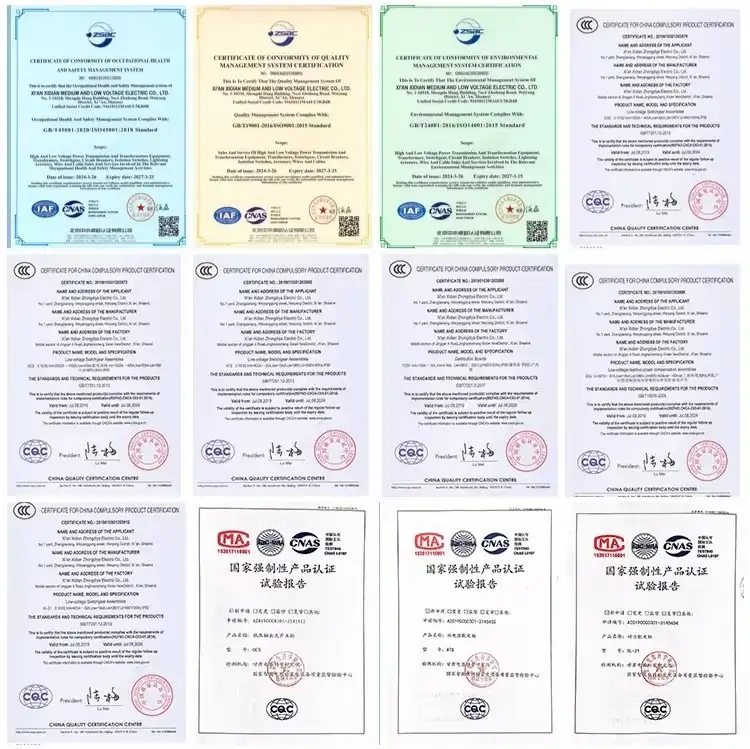
There should be paperwork with every order for an indoor vacuum circuit breaker. You should ask for the type-test reports, routine-test records for your batch, wiring and outline drawings, the secondary plug pinout, manuals, certificates, a list of spare parts, and maintenance instructions. For switchgear OEMs, the drawings are very important because they show where the mounting points are, how high the busbar is, how big the truck is, and where the interlocks are. These details determine whether or not a breaker fits in the cabinet. It is important to keep accurate records, as stated in NFPA 70B, the standard for maintaining electrical equipment. This means that your end users will need information on operation and maintenance anyway. Clear documents also speed up the approval process for new requirements.
ZN39 Indoor Vacuum Circuit Breaker: Data and Design Features
ZN39 Technical Data
The ZN39 indoor vacuum circuit breaker is a 12 kV unit for use with indoor switchgear. It works in temperatures ranging from -40°C to +40°C, with an average of less than 35°C over 24 hours. The average daily relative humidity can reach 95% and the average monthly relative humidity can reach 90%. The elevation should stay at or below 1,000 m. There are at least 20,000 operations, which is twice as many as the 10,000 IEC M2 operations, and the break time is 15 ms or less. The design is approved by both IEC 62271-100 and CE. Talk to our engineers about the short-circuit breaking current and rated current for your panel before you place your order.
Mechanism, Seismic, and Anti-Fouling Design
Because the ZN39's mechanism is based on a modular spring, a technician can easily replace individual parts, which reduces downtime. In places that are likely to have earthquakes, reinforced brackets make the system more stable, and high-creepage porcelain sleeves help the breaker deal with dirty air. Both of these points address common OEM concerns: a mechanism that works the same way over many operations, and a dust-resistant surface that acts as an insulator. Our factory uses automated assembly to keep differences between units to a minimum, and testing is done three times. When you build your own indoor vacuum circuit breaker, consistency is most important because the same timing and travel make it easier to put together the cabinet and service it later.
Series Options and Where the ZN39 Fits
There are two types of the ZN39 indoor vacuum circuit breaker. The ZN39-E Economy series is the best in terms of pricing for projects. The ZN39-S Smart series, meanwhile, is equipped for the Internet of Things and can monitor conditions in real time. We may adapt voltage ratings, communication interfaces and terminal layouts to suit regional requirements. The breaker protects transformers, motors and feeders in substations, industrial facilities, commercial buildings including hospitals and civic infrastructure. The maintenance staff may detect changes earlier when anything occurs in a substation by using condition monitoring. Send us a photo of your cabinet and we will make it fit.
Selecting and Sourcing an Indoor Vacuum Circuit Breaker
A Practical Selection Sequence
The selection of an indoor vacuum circuit breaker requires you to determine the use of the indoor vacuum circuit breaker. Is it for a transformer, motor, feeder, generator, capacitor bank, incoming electricity or bus section? Then know the rated voltage, insulation level, rated current, short-time withstand current, peak withstand current and breaking current, which should be 31.5 kA or 40 kA. Then check the breaker operation with the control voltage, the relay, the additional contacts and the rack system. Finally, examine the mechanical endurance for the number of operations predicted per year. There is no SF6 gas to be dealt with in vacuum technology and it is typical in indoor medium voltage applications. In contrast, air circuit breakers are mostly employed for low voltage systems. Not just the cost of purchasing them, but also maintenance access, uptime and replacement speed should be utilized when comparing fixed and withdrawable designs.
Interchangeability and Supply Planning for OEMs
For a switchgear OEM, interchangeability is the factor that decides whether a breaker truck may be placed in any cabinet without being fixed. Before approving samples, ensure the pole center distance, truck width, busbar height, secondary plug pinout, shutter function, and interlock points are correct. Preplan the sample stage since before substantial orders can be made drawings, a construction and testing need to be done for a new standard. Yearly supply agreements with monthly releases are then arranged which allows both parties to prepare for materials and capacity. As an interior vacuum circuit breaker provider, learn about their load capacity, packaging for export, availability of replacement parts, and approach to engineering revisions. Our products are employed in renewable energy projects, power engineering, steel and metallurgy, rail transportation, State Grid systems, and more. We are delighted to negotiate OEM and batch manufacturing.
Installation, Maintenance, and Troubleshooting
Planned maintenance extends the life of the devices. Schedule inspections according to frequency of system use, environment and failure history. Check timing against your baseline. Check springs, latches, lubricants, auxiliary contacts, terminals, insulating surfaces, and contact-wear indicators. “Start with simple causes of common mistakes. If the breaker will not shut, check the coil voltage, spring charge, and latch position. Check the guide rails, lubrication and cabinet alignment to verify whether the racking mechanism is blocked before applying force. In case contact resistance is excessive, main connections and contact over-travel should be checked. Keep a log of each indoor vacuum circuit breaker operation. Timing or motor run-time patterns might be an early indicator of deterioration. For locations over 1.000 meters, inquire about our plateau-type equipment that can operate up to 4.000 meters.

Conclusion
A vacuum interrupter that keeps its vacuum, a spring mechanism and racking system that move smoothly, and an environment and installation that match the design are all parts of an indoor vacuum circuit breaker that work together to make it last. IEC 62271-100 divides classes into mechanical and electrical ones. Buyers should make sure that both classes are right for the job and check them with type-test reports, routine-test records, and drawings. There are at least 20,000 mechanical operations in the 12 kV ZN39, which shows how these points show up in a certain model. For OEMs, a good choice includes ratings that have been checked, parts that can be swapped out, and planned maintenance.
FAQ
1. How many operations should an indoor vacuum circuit breaker handle?
Class M2 is set at 10,000 operations by IEC 62271-100. Pick based on switching frequency, as feeders and transfer schemes that happen often need higher counts. The ZN39 can do at least 20,000 operations.
2. Can I use the ZN39 above 1,000 m?
Up to 1,000 m, the standard ZN39 works well. Higher sites have less effective external air insulation, so ask us about equipment that works up to 4,000 meters above sea level.
3. How do I check for vacuum loss?
A power-frequency withstand test should be done across the open contacts. If the gap breaks at a certain voltage, it means that the vacuum has been lost, so take that interrupter out of service. Write down the number and the result.
4. What should I send for an indoor vacuum circuit breaker quotation?
Send the destination, rated voltage, rated current, breaking current, control voltage, drawings, and the type of device (fixed or withdrawable). Then, our engineers pick a model and make sure the interface fits.
Request an Indoor Vacuum Circuit Breaker Quote From Xi'an Xikai
A company in Xi'an called Xikai makes the ZN39 and other medium-voltage gear for switchgear OEMs, distributors, and project teams. As a company that makes indoor vacuum circuit breakers, we can make custom configurations and equipment for plateaus up to 4,000 meters in height. We will look over the fit and delivery after you send your ratings, cabinet drawings, and quantities to serina@xaxd-electric.com, amber@xaxd-electric.com, or luna@xaxd-electric.com. For more information, go to xaxd-electric.com.
References
- IEC 62271-100 High-Voltage Switchgear and Controlgear – Part 100: Alternating-Current Circuit-Breakers, 2021
- IEC 62271-1 High-Voltage Switchgear and Controlgear – Part 1: Common Specifications, 2017
- IEEE Std C37.04 Standard for Ratings and Requirements for AC High-Voltage Circuit Breakers with Rated Maximum Voltage Above 1000 V, 2018
- CIGRE Technical Brochure 510 Final Report of the 2004–2007 International Enquiry on Reliability of High Voltage Equipment, Part 2: Reliability of High Voltage SF6 Circuit Breakers, 2012
- The Vacuum Interrupter: Theory, Design, and Application, 2008
- NFPA 70B Standard for Electrical Equipment Maintenance, 2023
