
How to Select a Low Voltage shunt Capacitor: A Practical Guide
2026-11-03 17:28:48
To select a low voltage shunt capacitor, start with four facts: your system voltage, frequency, measured load in kW, and present versus target power factor. Use them to calculate the kvar you need. Then match that figure to a capacitor with the right voltage rating, self-healing film, and protection devices. Check harmonics before you buy, because drives and rectifiers can overload standard units. Finally, compare suppliers on batch consistency and tested capacitance, not only on price. I wrote this guide for panel builders, wholesalers, and technical buyers who order standard 400 V units in volume.

Why Selecting the Right Low Voltage shunt Capacitor Matters
Poor Power Factor Costs More Than Most Buyers Expect
Welders, motors, generators, pumps, compressors, and HVAC systems are all things that use reactive power. That power doesn't do anything useful, but it still moves through wires and transformers. As the power factor goes down, the current goes up, heat and cable losses go up, and transformer capacity that could be used for real load is used up. In some places, utilities also charge extra for power factors that are too low. When you pick the right low voltage shunt capacitor, it puts that reactive power next to the load, which means the network carries less current. The trouble stays where it is with a unit that is too small. If it's too big, it can push the system into leading power factor and stress the equipment. For both reasons, selection is important.
How a Low Voltage shunt Capacitor Works
To connect a low voltage shunt capacitor to the load or the distribution bus in parallel, part of the lagging current that inductive equipment draws is canceled out by its leading current. This makes the phase gap between voltage and current smaller. Series capacitors are in the line path and are not the same as parallel capacitors. This is important to keep in mind. Depending on the area, 230 V, 400 V, or 415 V ratings are common for systems below 1,000 V. For this reason, many companies in the US use 480 V instead. Before they order, I always tell buyers to make sure that the stated voltage matches the real system. A low voltage shunt capacitor can be placed at a motor, on a panel bus, or in an automatic bank.
What a Modern Low Voltage shunt Capacitor Is Made Of
Self-healing metalized polypropylene film is used in most new designs. If there is a small dielectric fault, the thin metal layer evaporates around it, and insulation returns in a matter of microseconds. The unit keeps going. There should also be discharge resistors and an overpressure disconnector in good designs. These break the internal connection if gas builds up at the end of its life. According to IEC 60831, discharge resistors must lower the voltage at the terminals to less than 75 V within three minutes. Local rules may have tighter requirements. Because it stops oil leaks and makes mounting easier, dry-type construction with soft resin is often used in panel work.
Key Selection Criteria for a Low Voltage shunt Capacitor
Confirm Voltage, Frequency, and Connection
Start with the facts about the network: the nominal voltage, the frequency, the way it is connected, and the normal variation in voltage. A low voltage shunt capacitor's kvar output changes based on the square of the applied voltage. This means that a mismatch is bad on two levels: it causes the output to drop and adds stress. As an example, a capacitor that is rated at 30 kV at 460 V gives off about 22.7 kV on a real 400 V system, since (400/460)² is about 0.756. Also, frequency is important. A machine that can handle both 50 Hz and 60 Hz lets a panel builder serve more than one market with just one model. However, the output at 60 Hz is different from 50 Hz, so check the specs to be sure. Because heat shortens the life of capacitors, you should also check the humidity, temperature, air flow, dust, and elevation.
Calculate the kvar Your Low Voltage shunt Capacitor Must Supply
Use Qc = P × (tan φ1 - tan φ2). P is the amount of active power in kW, φ1 is the angle at your current power factor, and φ2 is the angle you want to reach. You want to raise the load of 500 kW from 0.75 to 0.95. Since the tangent values are between 0.882 and 0.329, you need about 277 kvar before you can make any useful changes. Use a power analyzer to measure demand during a normal production cycle instead of the transformer's nameplate to figure out P. There is a lot of overcompensation at light loads when nameplate sizes are used. You should only add room for planned growth if the controller can turn those steps off when demand drops.
Choose Step Sizes and Switching
Break up total kvar into steps that match your load. When loads change, smaller steps work best, but when processes are stable, bigger steps can work better. Most people mix 10 + 10 + 20 + 20 + 40 kvar, which only takes five steps and gives them fine control. Normal loads can be switched by contactors. It is best to use capacitor-duty contactors because the inrush current can be many times the normal current and melt regular contacts. Thyristor or combination switching works best for loads that change quickly, like spot welders. Then check the size of the conductors, short-circuit resistance, and coordination of the fuses. This is how much current a 30 kvar three-phase bank at 400 V needs: 43 A. Cable ratings need a margin above the rated current, usually 130 to 135%, depending on the standard.
Comparing Low Voltage shunt Capacitor Solutions for Industrial Loads
Fixed Banks Versus Automatic Banks
When the low voltage shunt capacitor is turned on, a fixed unit can handle a stable load, like a generator that always runs. These units are cheaper. Connect them to the load so that the low voltage shunt capacitor is never left connected when there is no load. A power factor controller controls when steps are in and out of automatic banks. This works well for factories with shifting shifts and different types of equipment. For the controller to work, there needs to be a current transformer in the right place with the right voltage, as well as reasonable delays between swapping and reconnecting. Commissioning problems often happen because the CT is put in the wrong place. Before I show buyers my options, I ask them how much the load changes from morning to night.
Harmonics and Detuned Systems
Harmonic currents are made by variable-frequency drives, UPS units, rectifiers, and inverters. As frequency goes up, a low voltage shunt capacitor's impedance goes down, which means it can take in those currents, get too hot, and become in resonance with the transformer. A normal low voltage shunt capacitor is not the same as a harmonic filter. If there are a lot of harmonic loads, you should first measure and then think about detuned reactors and low voltage shunt capacitors that can handle higher voltage. IEEE 519 sets harmonic limits at the point of shared coupling and can be used as a guide to rate a place. Standard self-healing units usually work well as long as measurements show little distortion.
Matching Capacitor Type to the Load
Dry units are small and can fit inside panels, while oil-filled units are better for some thermal or dielectric needs. When it comes to size and ease of use, dry-type cylindrical units work best for most OEM panels and wholesale capacitor cabinets. Write down the details, such as the voltage, frequency, kvar, temperature category, harmonic conditions, service life, measurements, safety measures, and standards. Cranes and welders need to be able to switch quickly, but pumps and fans can usually work with contactor banks. Look at the maximum voltage, kvar value, duty class, safety features, and lifetime cost of each option before making a choice. If units break down quickly, a lower purchase price isn't as appealing.
BKMJ0.46-30-3 Low Voltage shunt Capacitor: Specifications and Fit
Core Specifications
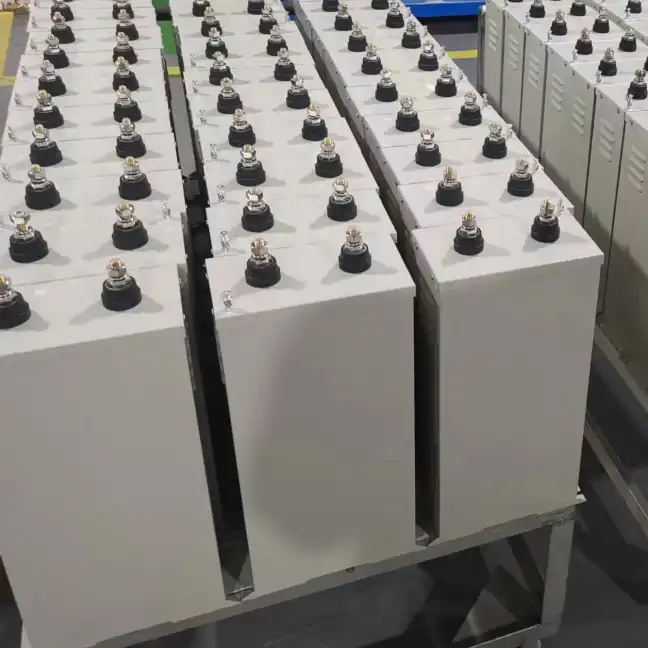
There are three phases in the 400V self-healing capacitor-cylindrical BKMJ0.46-30-3. The name means that the voltage is 0.46 kV, there are three phases, and the reactive power is 30 kvar. It works at 50 Hz or 60 Hz and has a rated voltage range of 250 V to 525 V. There are versions that go up to 2000 V. The case is small (about 242 mm tall), light, and has a grounding bolt built in. The can is filled with PU resin, which is a soft resin. The self-healing design doesn't need any maintenance, and it's easy to wire. It fits a standard size for low voltage shunt capacitors in capacitor cabinets, so it can be used in layouts that are already in place.
Where It Fits
This model can be used to fix the power factor of CNC tools and assembly lines in factories. At renewable energy sites with inverters, it can provide reactive power, but first check for harmonics, as we talked about above. Its small size and light weight make it easy to replace older capacitor banks and tight cabinets in business buildings like shops and hospitals. The design is meant to last for more than 100,000 hours of use, which is based on the assumption that the voltage and temperature are stable. Heat is the worst thing for any dry-type capacitor, so make sure cabinets have air flow. Before you place a large order, make sure the recommended voltage is right for your spot.
Quality Control and Batch Consistency
People who have bought standard models tell me that the real risk is not the datasheet, but the capacitance drift from one batch to the next. IEC 60831 allows a capacitance range of -5 to +10%. Voltage withstand and capacitance measuring are part of standard tests. Our process includes checking the material, controlling the tension of the windings automatically, changing the load, checking the impulse voltage, and doing thermal shock tests. Our management is ISO 9001-certified, and we follow IEC and CCC rules. The factor of dissipation stays below 0.2 W/kvar. For every shipment, ask for a capacitance test record. This way, you can compare lots on your own and find drift before the units get to your panels.
Installation, Common Mistakes, and Procurement Checklist
Installing and Commissioning Safely
Put each low voltage shunt capacitor close to the magnetic load or at a good low-voltage bus where air can flow. Keep it away from sources of heat, water, dust, corrosive gas, and vibration. Follow the approved wiring plan, the order of the phases, and the electrical code in your area. Connect the grounding bolt to the case and make sure that all the fuses, breakers, contactors, and discharge devices work with the current going through the low voltage shunt capacitor. During commissioning, check the target power factor, switching delays, reconnection time, and the location and polarity of the CT. Once you're done, write down the voltage, current, capacitance, power factor, harmonics, and response for each step. Installation of capacitors in the US is covered by NFPA 70, so have your inspector look over Article 460.
Selection Mistakes to Avoid
Most problems in the field are caused by not fully assessing the site, not by the low voltage shunt capacitor itself. When you only look at the transformer grade to figure out kvar, you often get too little or too much relief. Ignoring harmonics and voltage tolerance can shorten the life of a unit, and using constant units on loads that change can cause leading power factor. Heat is another quiet cause. As a general rule, life expectancy drops by about half for every 7 to 10°C above the rated limit. This means that ventilation is important. Most of the time, a swollen can means that the overpressure disconnector has worked and the unit needs to be replaced. Last but not least, don't just judge sellers by their unit price. The total cost of the job is affected by test records, paperwork, warranty, and delivery support.
RFQ Checklist and Final Decision Steps
A clear request for quotes leads to quotes that are similar. Let the seller know about the voltage, frequency, phase configuration, active load, present and target power factor, required kvar, load profile, harmonic data, installation conditions, quantity, destination, and preferred Incoterms when you ask for a quote for a low voltage shunt capacitor. Find out from providers about their datasheets, drawings, test results, certifications, warranty terms, wait times, and experience exporting. Then, just follow these steps: decide what you want to achieve, get measured data, choose a fixed, automatic, or detuned design, choose the enclosure and protection, and check the results after the system is up and running. If you want to place an order every month, you should also ask about batch size and stock planning, since a steady supply is just as important as the first shipment.

Conclusion
The unit must match the measured site data in order to be chosen as a low voltage shunt capacitor. The grade is based on the system voltage, frequency, and connection. The kvar method takes the recorded load and power factor and turns them into a size. For stable loads, fixed banks work best, automatic banks work best for changing loads, and harmonic-rich sites need to be measured and often have their reactors detuned. An electrometallized film that heals itself, discharge resistors, and a pressure-sensitive disconnector protect the unit. Correct installation, ventilation, and commissioning also extend its useful life. It shows how a standard 30 kvar model with a small size, a grounding bolt, and PU resin potting can be used in panel work. Smart choices don't just look at price; they also look at how consistent the tested capacitance is, the documentation, and the total cost of the project.
FAQ
1. What does a low voltage shunt capacitor do?
It connects to the load in parallel and provides reactive power in the area. This makes the power factor better, cuts the line current, and frees up space in the generator and cables.
2. Can I use a standard capacitor on a harmonic-rich network?
Not until you check. First check for harmonics, then think about detuned reactors and a higher voltage rating, since standard units can get too hot or resonate.
3. Is a 400 V unit suitable for a 415 V system?
Not all the time. Before you buy, make sure that the datasheet's rated voltage, tolerance, and kvar match the voltage in your device.
4. Which documents should I request from a supplier?
You should ask for test reports, certifications, warranty terms, datasheets, drawings, and capacitance records for each batch.
Request a Low Voltage shunt Capacitor Recommendation from Xi'an Xikai
The company Xi'an Xikai sells low voltage shunt capacitors and has 7 product categories, 34 lines, patented technologies, and tools that can work at elevations of up to 4,000 meters. We will suggest a good BKMJ0.46-30-3 configuration after you send us your voltage, frequency, kvar, and quantity to serina@xaxd-electric.com, amber@xaxd-electric.com, or luna@xaxd-electric.com. To find out more, go to xaxd-electric.com.

References
1. IEC 60831-1: Shunt Power Capacitors of the Self-Healing Type for AC Systems up to 1000 V, 2014
2. IEEE Std 18: IEEE Standard for Shunt Power Capacitors, 2012
3. IEEE Std 1036: IEEE Guide for the Application of Shunt Power Capacitors, 2020
4. IEEE Std 519: Recommended Practice and Requirements for Harmonic Control in Electric Power Systems, 2022
5. NFPA 70: National Electrical Code, 2023
6. Schneider Electric: Electrical Installation Guide, 2016