
Vacuum Circuit Breaker: Working, Benefits & Applications
2026-10-16 17:18:59
A vacuum circuit breaker (VCB) is a medium voltage switching device which stops fault currents by quenching the electrical arc in the sealed vacuum interrupter chamber. The vacuum affords almost negligible dielectric recovery time, enabling the arc to be extinguished quickly (usually within 15 ms) without the fire hazard of oil breakers or the environmental worry of SF6 gas units. Modern vacuum circuit breakers are used in power grids, industrial facilities, renewable energy source substations and urban infrastructures and are available for voltage classes from 12 kV up to 40.5 kV and higher. In this tutorial we’ll take you through how they function, why they’re worth picking and how to source the perfect one.
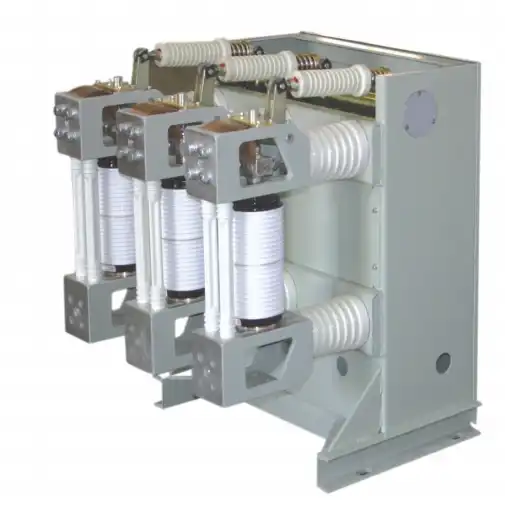
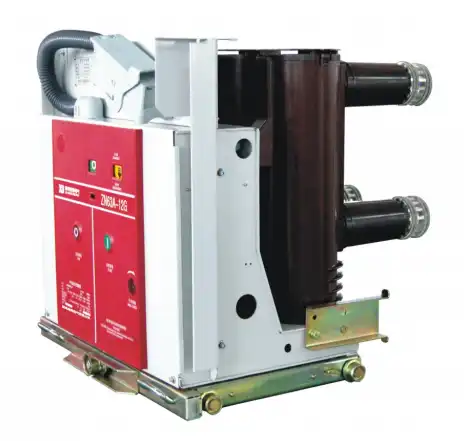
Understanding Vacuum Circuit Breakers: Working Principles and Components
How Arc Quenching Works in a Vacuum
When the contacts of a vacuum circuit breaker open under load, the metal vapor from the contact surfaces keeps the arc going for a short time. The arc plasma spreads out right away when the current goes to zero because the medium around it is a vacuum (residual pressure below 10⁻³ Pa). The contact material, which is usually a blend of copper and chromium, condenses back on the electrode surfaces in microseconds, returning the full dielectric strength. Because of this mechanism, VCBs are much faster and cleaner than oil or SF6 alternatives.
Key Components and Their Roles
There are three main parts that make up every vacuum circuit breaker. The vacuum interrupter puts the moving and fixed contacts inside a clay or glass case that can't be opened. The spring-operated system saves mechanical energy that can be used over and over again to open and close thousands of times. The insulating pole assembly, which can be epoxy-encased or air-insulated, keeps the interrupter in place and makes sure there is enough space between the phases. These parts define the electrical and mechanical performance range of the breaker as a whole.
Rated Electrical Characteristics
A VCB is usually judged by four things: its rated voltage (12 kV or 40.5 kV), its rated normal current (630 A to 3150 A), its rated short-circuit breaking current (25 kA, 31.5 kA, or 40 kA), and its lightning impulse withstand voltage. For example, Xi'an Xikai's ZN39 Indoor Vacuum circuit breaker is rated at 12 kV, has a breaking time of ≤15 ms, and has a mechanical life of ≥20,000 operations. These specs are exactly what IEC 62271-100 and GB 1984 say it should be.
Advantages and Maintenance of Vacuum Circuit Breakers
Why VCBs Outperform Oil and SF6 Breakers
Oil circuit breakers can catch fire and need to have oil changed often. Electrically, SF6 units work well, but they use a gas that is 23,500 times more powerful than CO2 at warming the Earth. Because of this, they are coming under more and more governmental pressure in North America and Europe. Both problems are solved by a vacuum circuit breaker. The sealed interrupter doesn't need to be refilled with insulating medium, doesn't make any harmful by-products, and works quietly, which is great for indoor settings like data centers or hospitals.
Inspection Routines and Service Intervals
The vacuum interrupter doesn't need any upkeep in between overhauls. But the spring mechanism works better when it is oiled every 2,000 operations or three to five years, whichever comes first. Every time an inspection is scheduled, technicians should check the contact wear indicators. Most manufacturers mark the interrupter housing with a maximum contact erosion depth of 3 mm. Every year, you should check the secondary circuit terminals and auxiliary contacts for corrosion or loose connections.
Troubleshooting Common Field Issues
Most of the time, there are two problems that come up in field service reports. A dielectric withstand test on the open interrupter can show if the vacuum is getting worse; a value below the rated 1-minute power-frequency withstand voltage means the interrupter needs to be replaced. The second is a stiff mechanism during handcart racking, which is generally caused by not lubricating the cam-rollers enough or having guide rails inside the switchgear cabinet that are not lined up correctly. It's better to do preventative upkeep on both problems than to fix them after the fact.
Types and Specifications: Selecting the Right Vacuum Circuit Breaker
Indoor Fixed vs. Withdrawable (Handcart) Types
Breakers that are fixed inside can be directly connected to ring-main units and small secondary substations. Withdrawable breakers, also called "handcart" breakers, like the ZN39 series, are mounted on a truck chassis that goes into KYN28-type cabinets. This lets the live bus be safely isolated without having to separate the bus bars. Handcart interchangeability is a must for OEM switchgear makers because it decides how well cabinets work with each other across a whole product line.
Voltage Class and Current Rating Selection
To break a short circuit at 12 kV, the choices usually range from 630 A to 2000 A for normal current and from 20 kA to 40 kA. Moving to 24 kV or 40.5 kV requires a lot more insulation clearance. Solid-embedded pole technology makes up for this by covering the interrupter in epoxy resin instead of relying on air gaps. When switchgear engineers work on substations for mines or renewable energy, they usually set the minimum breaking capacity at 31.5 kA. This is because fault current levels in these networks often go above 25 kA.
Leading Brands and Where They Fit
The 3AF and 3AH models from Siemens are used as a functional standard by many Chinese designs, such as the ZN12-12 lineage. Because it is flexible, ABB's VD4 platform is often chosen for utility projects in Europe. Schneider Electric's Evolis is made for industrial uses that do a lot of spinning. The ZN39 series from Xi'an Xikai has the same level of performance as these international brands. It also has the added benefit of being directly compliant with both IEC and GB standards and having handcart dimensions that have been tested to be interchangeable with KYN28 cabinets. This is especially useful for Asian and Middle Eastern OEM customers who are buying in bulk.
Procurement Guide: Buying Vacuum Circuit Breakers for Your Business
Cost Factors and Budget Planning
The per unit cost of 12 kV vacuum circuit breaker depends upon its breaking capability, current rating and kind of working mechanism. When the procurement teams enter a new regional market, they should take into account four kinds of costs: the base unit price, the stock of spare interrupters, the mechanism service kits, and the charges for the conformity testing. Many OEM switchgear manufacturers operate using annual framework agreements. This allows suppliers to block off manufacturing capacity and the price per unit is cheaper than a spot purchase.
Evaluating Supplier Qualifications
Your vacuum circuit breaker provider should be ISO 9001 certified, have type-test results from a recognized third-party lab (CSEI, KEMA, or an equivalent), and be on relevant qualified supplier lists, like those kept up by China's State Grid or Southern Grid. For repeat customers, lead times for common setups are usually four to six weeks. For new specifications like a non-standard current rating or a changed truck size, sampling usually takes two to three months. This is how long OEM procurement managers should plan for the sample-to-approval cycle.
After-Sales Support and Delivery Logistics
Reliable after-sales service covers multilingual technical manuals, CAD designs for cabinet integration and a dedicated application engineer to troubleshoot difficulties in the field remotely. In the case of shipping products to South Asia, Southeast Asia or the Middle East, the packaging must be resilient against humidity and vibrations in the course of maritime freight. Good vacuum circuit breaker manufacturers consider this, utilising sealed moisture-barrier packing and ocean-rated timber crating.
Practical Applications and Future Outlook of Vacuum Circuit Breakers
Power Networks and Industrial Plants
During its service life, a vacuum circuit breaker used in a 10 kV distribution network may complete tens of thousands of switching operations without any appreciable loss of performance. They are utilised in steel industries and petrochemical facilities for protecting motor feeds and transformer starters when fault currents are on the order of 31.5 kA. Field data from many State Grid installations suggest mechanical parts can live far beyond 10,000 cycles in continuous service. This supports the demand for higher cycle class mechanisms in high operation frequency applications.
Renewable Energy and Infrastructure Growth
Medium voltage collection systems with capacitor banks and transformer feeders, which are turned on and off rather often, link solar and wind farms to the grid. Vacuum circuit breakers are also well suited for capacitive switching as long as the device has a Class C2 re-ignition rating per IEC 62271-100. Other development sectors include urban rail, data centers and water treatment facilities, which all have high requirements for compact footprints and low noise emissions.
Digital Monitoring and the Path Forward
The IoT-enabled variants like ZN39-S series have sensors integrated in that convey information to building management or SCADA systems regarding the number of operations, movement of the contacts and status of the spring charge. The shift from time-based to condition-based maintenance minimises unnecessary downtime and increases asset life. The market is moving quicker to hoover technology at the higher voltage levels due of environmental pressure on SF6 equipment. Test projects on 72.5 kV vacuum breakers are already under progress in Europe and Asia.
Conclusion
Vacuum circuit breakers have proven themselves to be the best way to switch between medium-voltage electrical systems around the world. They can put out arcs without using gas or oil, last for tens of thousands of operations, and work with digital monitoring systems, so they can meet almost all of the concerns that utility engineers and OEM switchgear makers have. This generation of equipment is shown by the ZN39 Indoor Vacuum circuit breaker, which is rated at 12 kV, tested to ≥20,000 mechanical operations, and made so that handcarts can be swapped out in KYN28 cabinets.
FAQ
1.What does breaking capacity mean for a vacuum circuit breaker?
Breaking capacity—expressed in kA, such as 31.5 kA or 40 kA—is the maximum fault current the breaker can safely interrupt. Selecting below the network's prospective short-circuit current risks breaker failure during a fault, so engineers always confirm the available fault level at the installation point before specifying a unit.
2.How long does a vacuum interrupter last?
A well-maintained vacuum interrupter typically lasts 20 years or the rated mechanical life of the mechanism, whichever comes first. Vacuum degradation is the primary failure mode; an annual dielectric withstand test on the open contacts detects it early.
3.What is handcart interchangeability, and why does it matter?
Handcart interchangeability means a replacement vacuum circuit breaker truck slides into an existing cabinet without dimensional modification. For OEM manufacturers supplying multiple customers, this guarantees that field replacements are straightforward and do not require cabinet rework.
4.Can a vacuum circuit breaker handle capacitor bank switching?
Yes, provided it carries a Class C2 rating per IEC 62271-100, which certifies a very low probability of re-ignition during capacitive switching. Using a non-rated unit risks voltage escalation that can damage capacitor banks.
5.What certifications should I require from a VCB supplier?
Request ISO 9001, IEC 62271-100 type-test reports from an accredited laboratory, and—for export markets—CE marking. Appearance on the State Grid or Southern Grid qualified supplier list is strong additional evidence of product reliability for Chinese-market procurement.
Partner with Xi'an Xikai for Your Next Vacuum Circuit Breaker Order
Breaking capacity, which is given in kA and can be 31.5 kA or 40 kA, is the biggest fault current that the vacuum circuit breaker can safely stop. If engineers choose a unit below the network's expected short-circuit current, the breaker could fail during a fault. That's why they always check the fault level at the installation point before choosing a unit.

References
1. IEC 62271-100: High-Voltage Switchgear and Controlgear – Part 100: Alternating-Current Circuit-Breakers, International Electrotechnical Commission, 2021.
2. GB 1984-2014: AC High-Voltage Circuit Breakers, Standardization Administration of China, 2014.
3. CIGRE Working Group A3.27, The Impact of the Application of Vacuum Switchgear at Transmission Voltages, CIGRE Technical Brochure 589, 2014.
4. Greenwood, A., Vacuum Switchgear, IET Power and Energy Series, Institution of Engineering and Technology, 1994.
5. Smeets, R. P. P. et al., "Interruption of Small Inductive Currents with Vacuum Circuit Breakers," IEEE Transactions on Power Delivery, Vol. 13, No. 3, 1998.
6. EPRI (Electric Power Research Institute), Distribution Switchgear Reliability and Maintenance Guide, EPRI Report 1024002, 2012.