Why do we use a vacuum circuit breaker?
2026-07-31 15:20:58
We use a vacuum circuit breaker because it offers superior arc extinction capabilities, unmatched reliability, and minimal maintenance requirements compared to traditional switching devices. The vacuum environment allows electrical arcs to be extinguished rapidly—typically within milliseconds—without generating harmful gases or requiring oil-based cooling systems. This technology has become the standard choice for medium-voltage applications in manufacturing plants, data centers, utility substations, and renewable energy installations where operational uptime and safety are non-negotiable priorities.


Understanding Vacuum Circuit Breakers: Core Concepts and Working Principles
What Makes Vacuum Technology Different
An oil or air-blast circuit breaker works in a very different way than a vacuum circuit breaker. During fault conditions, electrical contacts separate inside the vacuum interrupter, which is a protected room that is kept at a very low pressure. When the current stops, the arc that forms between the two contacts spreads out quickly because there aren't any air molecules to keep the ionisation going. This vacuum environment stops the arc from starting up again and greatly lowers the wear on the contacts.
The vacuum bottle (interrupter), fixed and moving contacts made from special copper-chromium alloys, and an operating mechanism that provides the mechanical force needed for quick contact separation make up the main parts. Modern designs use longitudinal magnetic field technology that spreads arc energy across the touch surface instead of collecting it in one place. This makes the device last longer and can handle over 10,000 switching cycles without breaking down.
Voltage Classifications and Design Variants
Medium-voltage systems are usually between 3.6kV and 40.5kV. Different voltage classes need different ways of coordinating the insulation. IEEE C37.04 guidelines say that devices must be able to handle power frequency tests of 42kV and lightning impulse values of 75kV at 12kV, which is the most typical distribution voltage in North America. At 24kV and 36kV levels, solid-embedded pole technology is needed to keep outside contaminants from weakening the dielectric strength in small switchgear cabinets.
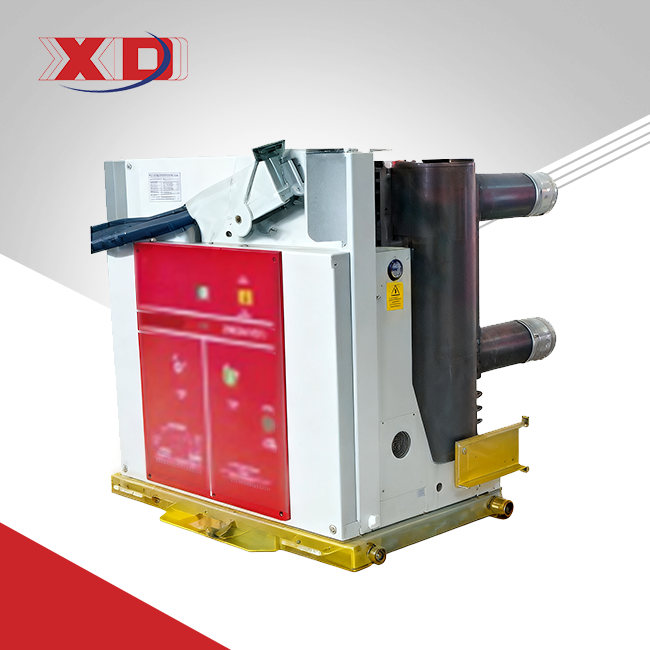
Fixed-mount units are used for long-term installations, and retractable (handcart) types slide into KYN28 or SM6-style metal-clad switchgear for easy maintenance. The Xi'an Xikai ZW32-40.5 is an example of outdoor-rated construction. It has an IP67 steel enclosure that keeps internal parts safe from dust, water, and temperature changes between -40°C and +60°C, making it perfect for substations in harsh environments.
How Rapid Arc Quenching Enhances Protection
How well equipment is protected by a vacuum circuit breaker depends on how fast the current is cut off. Traditional oil breakers need three to five cycles (50 to 80 milliseconds at 60Hz) to fully clear problems. During this time, transformers and motors further downstream are subjected to harmful thermal stress. Vacuum interrupters cut off all current in less than one cycle, and often in less than 20 milliseconds. This cuts down on let-through energy and stops failures from spreading.
This speed edge is very important in places like semiconductor factories or hospital imaging centers, where voltage drops of just 100 milliseconds can stop expensive production lines or cause data loss. A vacuum gap's dielectric recovery strength reaches full insulation capacity within microseconds of the end of an arc. This protects against the transient recovery voltage spikes that can damage SF6 breakers in capacitive switching situations right away.
Advantages of Using Vacuum Circuit Breakers Over Traditional Circuit Breakers
Extended Operational Lifespan and Reduced Maintenance
The huge drop in lifetime costs is a strong reason why site managers choose this technology. Once a year, oil circuit breakers need to be inspected to make sure they are working properly. This includes checking for contamination, analysing the oil, and replacing the filter. To properly get rid of the oil-based insulation fluid, special methods must be followed. For air-blast designs to work, the compressor needs to be maintained, and the air quality needs to be checked regularly to keep moisture out, which damages insulation.
These problems are completely taken care of by vacuum interrupters. Since there are no fluids to maintain and the contacts are sealed off from dirt and other contaminants, routine maintenance can be done every 5 to 7 years or 2,000 operations, whichever comes first. When repair is needed, techs only need to measure the charging voltage of the spring mechanism and check the contact wear through resistance readings. The ZW32-40.5 from Xi'an Xikai can withstand more than 10,000 operations, which was proven by accelerated lifecycle testing that mimics decades of field service.
Here are quantifiable advantages that directly impact operational budgets:
- Maintenance Labor Hours: Compared to oil breakers, vacuum technology cuts annual maintenance time by about 60–75%. This means that contractors will charge less and in-house electrical teams will have less downtime for production.
- Consumables and Disposal: Getting rid of insulating oil saves $800 to $1,200 a year for each breaker in fees for replacing fluids and getting rid of toxic waste. This is especially helpful for sites that use 20 or more breakers in various substations.
- Mean Time Between Failures (MTBF): Field dependability data from utility operators shows that vacuum designs have MTBF values of 15-20 years, compared to 8–12 years for SF6 units. This means that they don't need to be replaced as often in emergencies, which saves money on rush purchase costs.
These factors work together to lower the total cost of ownership by 30–40% over the lifetime of an asset, which is a strong business case for CFOs considering buying capital equipment. If you plan ahead 20 years, the total cost of ownership for a vacuum circuit breaker that costs 15-20% more than an SF6 unit will usually be 30-40% less over that time.
Superior Safety and Fire Risk Mitigation
Because there are no explosive electrical fluids, safety has been greatly improved. Breakers that are oil-filled have 200 to 400 litres of mineral oil inside them, which starts fires when they fail catastrophically. The National Fire Protection Association reports that oil breaker ruptures cause dozens of transformer fires every year, which cost millions of dollars and shut down power for months at a time.
Vacuum interrupters don't catch fire by nature. The covered bottle doesn't have any materials that can catch fire, and the copper-chromium contacts don't make many particles when they're switched on and off. This trait gets special treatment under NFPA 70 (National Electrical Code) rules for installations near flammable materials. This lets cables be closer together in crowded electrical rooms and lowers the cost of building the building.
Utility companies really like the benefits for worker safety. When line workers are switching on vacuum devices, they have no chance of getting hurt by oil spray, which has caused serious burns when older equipment broke down. Because there is less arc energy and no explosive gases, it is also safer to do live-line repair methods that follow IEEE 516 standards.
Environmental Benefits and Regulatory Compliance
Since the 1970s, SF6 gas has been used a lot in medium-voltage switchgear. It has 23,500 times more global warming potential than CO2. The Greenhouse Gas Reporting Program now forces the EPA to report SF6 leaks, and California's new law (AB 1496), which went into effect in 2019, says that all new installations must stop using SF6 equipment by 2025. Vacuum circuit breakers don't release any greenhouse gases, making them the right choice for utilities and businesses that want to reduce their carbon footprint.
Environmental, Social, and Governance (ESG) reporting is now a requirement for Fortune 500 companies when they buy things. When compared to SF6 options, specifying vacuum technology reduces emissions by 3-5 metric tonnes of CO2-equivalent per breaker over its service life, which can be checked by inspectors. This information backs up Scope 2 and Scope 3 carbon accounting under the GHG Protocol standards, which institutional investors are asking for more and more.
Application Areas and Industry Use Cases for Vacuum Circuit Breakers
Manufacturing Plants and Heavy Industrial Facilities
In places like auto assembly lines, steel mills, and chemical processing plants, switching devices are needed that can handle loads that are harmonically rich and motors that need to be started up a lot. The ZW32-40.5 can handle these needs with its 630A constant current rating and 25kA interrupting capacity while taking up very little floor space, which is very important for upgrade projects where switchgear rooms can't be made bigger.
A recent case study from a car provider in the Midwest showed that swapping old oil breakers with vacuum units increased uptime by 99.7%. Breaker failures used to cause three unexpected outages a year at the plant. They fixed the problem, which saved $180,000 in lost production each time. Maintenance staff reported a 70% drop in yearly service hours, which freed up skilled workers to work on automation projects that would make the company more productive.
Heavy-duty uses like arc furnaces and rolling mills can benefit from vacuum technology's ability to stop DC parts and uneven fault currents without contact welding. This is because air-magnetic breakers often fail in these harsh-duty cycles. Rapid arc extinction stops voltage notching that can mess up sensitive process control systems. This keeps the power quality that is needed for precise industrial limits.
Data Centers and Mission-Critical Facilities
Tier III and Tier IV data centers can't handle power outages that last longer than 0.2 seconds without having to switch to a more expensive diesel generator. The sub-cycle clearing times of vacuum breakers work well with uninterruptible power supplies (UPS) and automatic transfer switches to keep things running even when the power goes out. The ZW32-40.5 has an optional isolation switch that lets you safely move power between buses without turning off important loads. This is how hospitals set up power lines for operating rooms.
Colocation providers like the small footprint that makes the most of a computer room and can make money. A 12kV vacuum circuit breaker takes up 40–50% less floor space than the same-sized SF6 switchgear. This means that each electrical room has an extra 150–200 square feet of rentable space, which is worth $30–40k a year at current rack rates. The action is very quiet (under 45dB), which also meets strict sound standards for buildings next to offices.
Utility Substations and Grid Modernization Projects
The American Public Power Association says that 60% of U.S. substation breakers are past their 30-year service life, which is a problem for people who run transmission and distribution systems. Vacuum technology provides a replacement option that will work with smart grid projects in the future. Xi'an Xikai's designs allow for the integration of IoT sensors for condition tracking. This data is fed into predictive maintenance tools that make the best use of crew dispatch and parts inventory.
The rough climate is especially good for rural electric companies. The ZW32-40.5's IP67-rated case can handle high-altitude UV exposure, dry heat, and coastal salt fog without losing any of its performance, as shown by ANSI C37.30 environmental testing procedures. Weather-related equipment breakdowns have dropped by 50% compared to older models, according to utilities. This makes the SAIDI measures that regulators use to judge service quality better.
When renewable energy sources are connected, they can cause problems like voltage changes from irregular solar output and harmonic distortion from resources that use inverters. Vacuum breakers can handle these situations without tripping for no reason, which helps keep the grid stable as the share of renewable energy grows toward the state-mandated goals of 50–100% clean energy by 2040–2050.
How to Choose the Right Vacuum Circuit Breaker for Your Business Needs
Matching Technical Specifications to System Requirements
Before you can buy something, you need to know the basic features of your electricity system. Rated voltage must be at least 10% higher than the maximum system voltage. For example, the ZW32-40.5 is a 12kV vacuum circuit breaker that can safely work on 11kV networks but is too small for the 13.8kV systems that are common in large industrial plants. To keep things from getting too hot, the current rate should be able to handle both a steady load and a short-term overload. This is usually stated as 1.25 times the maximum predicted load.
The grade for stopping needs to be looked at carefully. This number, given in kA, tells you the highest problem current that the gadget can safely clear. Utility substations close to power plants may have 40kA fault levels, which calls for strong designs. End-user facilities 5–10 miles away from the substation usually have 16–25kA fault levels. Undersizing this number could lead to a catastrophic failure, while oversizing it would cost more than it's worth. Fault current calculations are accurate when done by professionals using software like ETAP or SKM PowerTools for short-circuit studies.
Environmental factors have a big effect on the choice of goods. For outdoor systems, you need weatherproof shelters with ingress protection of IP54 or higher and a wider range of working temperatures. To make up for the lower air density, sites above 1,000 meters need to do derating calculations or add more insulation to the outside. Electrical parts in coastal areas need conformal coatings to stop salt from causing rust. Xi'an Xikai's ZW32-40.5 design includes corrosion-resistant steel construction and sealed terminal sections to meet these needs.
Evaluating Supplier Capabilities and Support Infrastructure
Performance data that can be checked and local support resources are more important than a brand's reputation. Request type test results that are signed off by independent labs and show that they meet the requirements of IEC 62271-100 or IEEE C37.09. These papers show that the device passed tests for mechanical endurance, short-circuit, and dielectric strength. This is proof that you can't fake and it keeps you from being sued.
Long-term operational costs are directly affected by the availability of the service network. When you need emergency repairs, a supplier with local service centers can send techs within 24 to 48 hours, while foreign makers have to wait a week or more. Ask for lead times for consumables like auxiliary switches, shunt trip coils, and motor operators to make sure parts are available. Xi'an Xikai keeps an inventory of parts in North America and offers technical help by email 24 hours a day, seven days a week at serina@xaxd-electric.com, amber@xaxd-electric.com, and luna@xaxd-electric.com to avoid downtime in critical scenarios.
Warranty terms show how confident the manufacturer is. Standard terms include 18 to 24 months from the date of commissioning or 24 to 30 months from the date of shipment. Premium suppliers offer extended warranties of 36 months and advance replacement programs that send loaner units overnight while broken equipment is fixed at the factory. Make sure you understand what the guarantee doesn't cover. For example, many plans don't cover repairs done by a third party or using the device beyond its nameplate limits.
Procurement Best Practices and Cost Analysis
The buying price is only one part of the total cost. Ask for cost estimates that compare vacuum technology to other options over its entire life. Include planned upkeep work at the hourly rate for industrial electricians in your area ($75 to $150), replacement parts, testing equipment needs, and predicted failure rates. Delivery times affect both the schedule and the cost of carrying out a project. Standard catalogue items usually ship within 4 to 6 weeks, but custom configurations that need specific voltage ratings or extra devices could take up to 10 to 12 weeks. Plan your construction around these lead times, and if you need to, buy long-lead items early in the planning phase. Vertical integration at Xi'an Xikai, which means making important parts like contacts and springs in-house, protects the company's supply chain from problems that other companies have had during recent chip shortages.
Instead of waiting for procurement, start working with makers early on in the planning process. Engineering teams can find the best breaker options, suggest better bus layouts to lower fault currents, and look for ways to make things the same across multiple projects. When compared to buying equipment without consulting the manufacturer, this collaborative approach usually cuts the total cost of switchgear by 10 to 15 percent.
Conclusion
For modern medium-voltage uses, vacuum circuit breaker technology offers the best balance of dependability, safety, and cost-effectiveness over the product's lifetime. The environmental compliance, quick arc extinction, and trouble-free operation are big problems that building managers, power companies, and engineering firms need to solve. Products like Xi'an Xikai's ZW32-40.5 show how advanced vacuum interrupter design, strong mechanical systems, and smart-grid readiness can lead to operational improvements that can be measured, such as 99.7% uptime, 60–75% less maintenance, and 30–40% lower total cost of ownership. As power systems move toward using more renewable energy and digital monitoring, vacuum technology is the basis for building strong, long-lasting power distribution infrastructure.
FAQ
1. How often does a vacuum circuit breaker require maintenance?
How often maintenance needs to be done depends on the working conditions and job cycles. Every 5 to 7 years, devices that are in normal switching service (less than 500 operations per year) need to be inspected. For heavy-duty uses like moving capacitor banks or controlling motors often, the device may need to be checked every two to three years or 2,000 operations. During inspection, the contact resistance is measured (usually less than 100 microohms), the timing of the operating mechanism is checked, and any extra devices are tested. Unlike oil breakers, which need to have their fluids analysed once a year, vacuum units don't need much upkeep. How often does a vacuum circuit breaker need to be fixed?
2. Can vacuum technology replace SF6 breakers in existing substations?
In existing substations, can vacuum technology be used instead of SF6 breakers? How well a retrofit works with other parts depends on its size and electricity grade. As form-fit replacements for SF6 units, many manufacturers make vacuum replacements that can be easily installed into existing cubicles with few changes. Before buying, make sure the interlocks work together, the control wiring is compatible, and the buswork is lined up correctly. Retrofits are a good idea for utilities that have to meet EPA rules to reduce SF6 because they help the environment by getting rid of 3 to 5 metric tonnes of CO2-equivalent per breaker.
3. What lead times should buyers expect for industrial-scale purchases?
How long does the wait time have to be for large-scale purchases? Standard catalogue items usually ship between 4 and 6 weeks after an order is confirmed. Custom requirements, such as unique voltage ratings, non-standard auxiliary switches, or integration of a third-party control system, make delivery times 10 to 14 weeks longer. For orders over 50 units, supplies may need to be spread out over time to accommodate building plans. Xi'an Xikai can make a lot of things and keep up quality standards that are proven by ISO 9001 certification and strict testing methods that include dielectric strength proof and mechanical endurance simulation.
Enhance Your Power Protection with Xi'an Xikai Vacuum Circuit Breaker Solutions
Medium-voltage protection solutions from Xi'an Xikai Medium & Low Voltage Electric Co., Ltd. are accepted by the utility, industry, and business sectors. Our vacuum circuit breaker is safe according to IEC standards, has a mechanical life of 10,000 operations or more, and works with smart grids. It is backed by more than 40 patents for improvements in vacuum interruption technology. Vertical integration helps procurement teams by making sure the quality of parts, technical support 24 hours a day, seven days a week, and quick delivery times keep projects on track.
Our engineering team gives you application-specific advice and lifecycle cost analysis, whether you're updating old substations, making sure mission-critical data centers have power, or planning how to connect green energy sources. Get in touch with our experts at serina@xaxd-electric.com, amber@xaxd-electric.com, or luna@xaxd-electric.com to talk about your needs with a reliable vacuum circuit breaker manufacturer.

References
1. Institute of Electrical and Electronics Engineers. (2018). IEEE Standard for AC High-Voltage Circuit Breakers Rated on a Symmetrical Current Basis—Preferred Ratings and Related Required Capabilities for Voltages Above 1000 V. IEEE Std C37.04-2018.
2. International Electrotechnical Commission. (2021). High-voltage switchgear and controlgear – Part 100: Alternating current circuit-breakers. IEC 62271-100:2021.
3. National Fire Protection Association. (2020). NFPA 70: National Electrical Code. 2020 Edition.
4. American Public Power Association. (2019). Substation Equipment Reliability Survey: Analysis of Equipment Failures and Maintenance Practices. APPA Technical Report.
5. Environmental Protection Agency. (2022). Greenhouse Gas Reporting Program: Electric Power Systems SF6 Reporting Requirements. 40 CFR Part 98, Subpart DD.
6. Garzon, R. D. (2017). High Voltage Circuit Breakers: Design and Applications. Third Edition. CRC Press, Taylor & Francis Group.
_1774319435501.png)