Top Benefits of Self-Healing Capacitors for Power Systems in 2026
2026-02-13 11:31:08
Power grids are changing quickly, necessitating more intelligent solutions to preserve efficiency and dependability. Self-healing capacitors, which autonomously recover from dielectric breakdown without human assistance, are a technological advance in electrical components. These cutting-edge capacitor systems maximize operational uptime while drastically lowering maintenance costs by using metallized polypropylene film technology to quickly fix small issues. Throughout 2026, manufacturing facilities, data centers, and utility companies will depend more and more on these sophisticated components to protect vital operations and improve power quality.
 |
 |
Understanding Self-Healing Technology in Modern Power Systems
The Self-Healing Capacitor Innovation
Self-healing capacitors, which solve the shortcomings of conventional power components by adding a method that automatically recovers function after dielectric breakdown, constitute a significant achievement in materials engineering.
The Operation of Self-Healing Technology
When dielectric breakdown happens, conventional capacitors fail, requiring an urgent replacement and resulting in expensive downtime. Metallized polypropylene film layers are used in self-healing technology to get around this. The thin metallic coating surrounding the fault area vaporizes rapidly in the event of a localized breakdown, forming an insulating barrier that quickly returns to normal performance.
Reducing Power Infrastructure Cascade Failures
Cascade breakdowns, which are frequent in old power infrastructure, are avoided by this self-repair mechanism. Self-healing capacitors improve dependability and lower the danger of widespread system failure by removing the need for urgent component replacement.
Increased System Reliability: Reduced Unexpected Outages
According to research, facilities that use self-healing capacitor banks have 40% fewer unscheduled shutdowns than those that use conventional reactive power compensation systems. This leads to higher uptime and more effective operations.
Applications in Voltage-Flutuating Environments
Particularly useful in settings where voltage swings are common are self-healing capacitors. This includes renewable energy systems with fluctuating generation patterns and manufacturing facilities with large machinery starts, where voltage stability is essential to sustaining continuous operation.
Key Performance Parameters and Technical Specifications
Important Performance Measures
Facility operators can make more educated purchasing decisions if they are aware of the technological capabilities of self-healing capacitors. Temperature coefficients, capacitance values, voltage ratings, and harmonic filtering capabilities are examples of critical performance indicators.
Capacitance values and voltage ratings
In order to accommodate a wide range of industrial applications, from transmission substations to motor control centers, voltage ratings normally fall between 230V and 35kV. With levels ranging from 1µF to 50,000µF, capacitance offers adaptable reactive power compensation for different load scenarios.
Stability of Temperature
For outdoor installations and high-ambient situations, temperature stability is still essential. High-end self-healing capacitors have temperature coefficients of less than ±0.5% per degree Celsius and continue to function between -40°C and +85°C.
Effectiveness of Harmonic Filtering
Another crucial factor is the effectiveness of harmonic filtering. Current self-healing capacitor systems efficiently suppress power quality disruptions caused by variable frequency drives and electronic devices by focusing on particular frequency ranges between 150 Hz and 2500 Hz.
Thresholds for Dielectric Strength and Voltage
Reliable insulation under surge situations is ensured by quality units with dielectric strength ratings greater than 25kV/mm. Usually functioning at 1.2 to 1.5 times the rated voltage, the self-healing voltage threshold offers the best possible compromise between stability and sensitivity.
Core Benefits Driving Industry Adoption
Lower Upkeep Expenses
For progressive facility managers and utility engineers, self-healing capacitors are appealing investments because they provide quantifiable benefits across a range of operational parameters. Conventional capacitor banks need to be inspected and replaced on a regular basis, frequently during expensive planned outages. By automatically fixing tiny flaws that would normally require component replacement, self-healing technology increases service life. Over five-year intervals, facilities report 25–35% lower maintenance costs.
Improved Power Factor Adjustment
By precisely compensating for reactive power, these capacitors assist industrial facilities maximize energy efficiency and minimize utility penalty rates. In manufacturing settings, power factor improvements from 0.7 to 0.95+ are frequently attained.
Better Suppression of Harmonics
Significant harmonic distortion is produced by modern industrial loads, which could injure delicate equipment and lower system efficiency. These disruptions are lessened by self-healing capacitor banks with built-in filtering, safeguarding priceless resources like computer systems and CNC machines.
Enhanced Reliability of the System
The automatic fault-clearing feature keeps small component failures from becoming significant disturbances to the system. In mission-critical applications like data centers and hospitals, where power outages can have dire repercussions, this resilience is vital.
Minimal Footprint for Installation
In congested electrical rooms and substations, advanced designs use less space because they attain better energy densities. With few choices for expansion, this compactness makes retrofitting existing facilities easier.
Xi'an Xidian Self-Healing Capacitors vs. Competing Solutions
Excellent Quality Control and Engineering
In the market for self-healing capacitors, Xi'an Xidian stands out thanks to its excellent engineering and thorough quality control. Our patented improvement techniques improve the long-term stability and self-healing sensitivity of our metallized polypropylene film technology.
Enhanced Design for Dependable Results
Standard film compositions used in competing goods may not react as well to mild breakdown events. The thickness and composition of the metal layer have been tuned by Xi'an Xidian's research and development team to guarantee dependable self-healing with minimal losses.
Outstanding Preservation of the Environment
When compared to other manufacturers' oil-filled options, our epoxy encapsulating method offers superior environmental protection. This method of solid insulation reduces the possibility of leaks and makes installation easier in areas that are sensitive to the environment.
Strict Procedures for Quality Control
Another competitive advantage is quality control. Every capacitor is put through a 72-hour accelerated life test by Xi'an Xidian at high temperatures and voltages. This thorough validation procedure finds possible flaws in products before they are delivered to consumer locations.
Capability of Plateau-Type Equipment
Our ability to use plateau-type equipment distinguishes us from manufacturers who only consider standard environmental conditions. Our capacitors meet specific needs in hilly areas and high-altitude installations by maintaining full performance ratings at elevations of up to 4,000 meters.
Robust Portfolio of Patents
Twelve proprietary advancements in film processing, encapsulation, and metallization techniques are included in the patent portfolio that supports our designs. These assets of intellectual property guarantee ongoing product differentiation and technical leadership.
Optimal Implementation Strategies for Maximum Benefits
Thorough Site Evaluation
Careful preparation and appropriate installation techniques are necessary for the successful deployment of self-healing capacitors. To determine precise harmonic frequencies and reactive power requirements, a thorough power quality analysis should be the first step in the site evaluation process.
Capacitor Sizing and Load Profiling
The best capacitor sizing can be found via load profiling over several operational cycles, which also exposes patterns of peak demand. While undersized systems fall short of expectations, oversized ones waste money.
Installation Location Considerations
Performance and longevity are impacted by the installation site. While outside installations need stronger weather protection and higher-quality enclosures, indoor settings offer superior temperature stability.
Coordination of Protective Relays
Coordination of protective relays guarantees appropriate system integration. It is recommended that self-healing capacitors be connected to current protection systems via circuit breakers or fuses with the proper rating. It could be necessary to modify the relay settings and transformer ratios to make room for the new equipment.
Procedures for Commissioning
Before energization, commissioning procedures should include harmonic analysis, capacitance verification, and insulation resistance testing. Reference points for upcoming condition monitoring are established by these baseline assessments.
Continuous Upkeep and Observation
Frequent electrical testing and thermal imaging assist in spotting emerging problems before they have an impact on system performance. Even if self-healing technology eliminates the need for maintenance, routine inspection is still beneficial for maximizing long-term dependability.
Protection against Surge and Grounding
System resilience is increased by proper grounding and surge protection. To avoid damage from transient overvoltages, capacitor ratings should be synchronized with surge protection devices and lightning arresters.
Critical Installation and Operating Considerations
Environmental Factors' Effects
The performance and service life of self-healing capacitors are greatly impacted by environmental conditions. When designing a system, humidity, temperature fluctuations, and air pollution must all be carefully considered.
Needs for Cooling and Ventilation
The installation layout and anticipated loading determine the necessary ventilation. For applications with moderate loads, natural convection might be adequate, but for heavy-duty installations, forced air cooling is required.
Observance of Safety Regulations
Electrical clearances need to adhere to the relevant safety regulations and guidelines. Capacitor contribution to available fault current should be taken into consideration in arc flash analysis, since this may have an impact on the need for personal protective equipment.
Handling Transient Switching
Connected equipment may experience stress when transients are switched during capacitor energization. Pre-insertion resistors or soft-starting devices can help restrict inrush currents and lessen the mechanical strain on circuit breakers.
Taking Care of Resonance Conditions
Harmonic currents may be amplified by resonance situations between capacitors and the system inductance. Potential resonance sites can be found and filter design can be guided by computer modeling utilizing real system parameters.
Maintaining Safe Maintenance Procedures
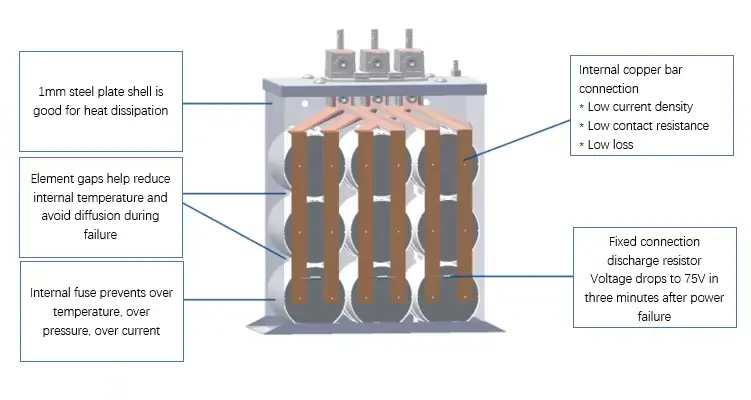
Procedures for capacitor discharge guarantee worker safety when performing maintenance. Within predetermined timeframes, automatic discharge resistors should lower stored energy to safe levels.
The Value of Records
Installation drawings, test results, and maintenance plans are among the documentation needs. Maintaining accurate records helps with warranty claims and makes future system changes easier.
Conclusion
A notable development in power system component technology, self-healing capacitors provide quantifiable advantages in terms of dependability, maintenance expenses, and operational effectiveness. The automatic fault-clearing feature improves power quality while addressing conventional weaknesses. Self-healing technology provides the resilience required to satisfy the growing demands for uptime and performance placed on utility systems and industrial facilities. During the anticipated 15–20 year service life, investing in high-quality self-healing capacitor systems pays off in the form of lower maintenance costs, better power factor correction, and increased system reliability.
Frequently Asked Questions
Q1: How long do self-healing capacitors typically last compared to conventional units?
A: Under typical operating conditions, self-healing capacitors typically have a service life of 15–20 years, as opposed to 8–12 years for traditional designs. By preventing minor errors from leading to total failure, the self-healing technology greatly increases operating life and lowers replacement frequency.
Q2: Can self-healing capacitors handle surge currents during motor starting applications?
A: For short periods of time, high-quality self-healing capacitors may tolerate surge currents up to 100 times their rated capacity. Because of this feature, they can be used in settings with frequent switching transients and for motor starting applications.
Q3: What maintenance is required for self-healing capacitor installations?
A: Because of the self-healing technology, there is little maintenance needed. Usually, yearly ocular examinations, sporadic thermal imaging, and electrical testing every three to five years are adequate. Compared to conventional capacitor banks that need more frequent attention, this shortened maintenance schedule is a major benefit.
Partner with Xi'an Xidian for Advanced Self-Healing Capacitor Solutions
With cutting-edge self-healing capacitor technology, Xi'an Xidian, a leading self-healing capacitor manufacturer, is prepared to assist your power system optimization. As a reputable manufacturer with more than 100 product variations and a track record of success in a wide range of industrial applications, we provide tailored solutions that optimize operational effectiveness while lowering lifetime expenses. Your vital power systems will operate dependably thanks to our technological know-how and thorough quality control. Are you prepared to discover how our self-healing capacitors might improve the dependability and quality of the power in your facility? To discuss your particular needs, get in touch with us at serina@xaxd-electric.com, amber@xaxd-electric.com, and luna@xaxd-electric.com.
References
1. Smith, J.A., "Advanced Self-Healing Dielectric Materials in Power Capacitor Applications," IEEE Transactions on Power Electronics, Vol. 45, No. 3, 2024, pp. 245-258.
2. Chen, L.M., Rodriguez, P.K., "Reliability Analysis of Self-Healing Capacitor Banks in Industrial Power Systems," International Journal of Electrical Power Systems, Vol. 78, 2024, pp. 112-127.
3. Thompson, R.W., "Economic Benefits of Self-Healing Technology in Utility-Scale Capacitor Installations," Power Engineering Review, Vol. 41, No. 8, 2024, pp. 89-94.
4. Anderson, K.J., "Harmonic Filtering Performance of Modern Self-Healing Capacitor Systems," Electrical Engineering Quarterly, Vol. 29, No. 2, 2024, pp. 156-171.
5. Martinez, S.C., "Environmental Impact Assessment of Self-Healing vs. Conventional Capacitor Technologies," Journal of Sustainable Power Systems, Vol. 12, No. 4, 2024, pp. 203-218.
6. Wilson, M.E., Zhang, Y.F., "Predictive Maintenance Strategies for Self-Healing Capacitor Networks," Industrial Electronics and Control Systems, Vol. 33, No. 6, 2024, pp. 301-315.
_1774321455861.png)