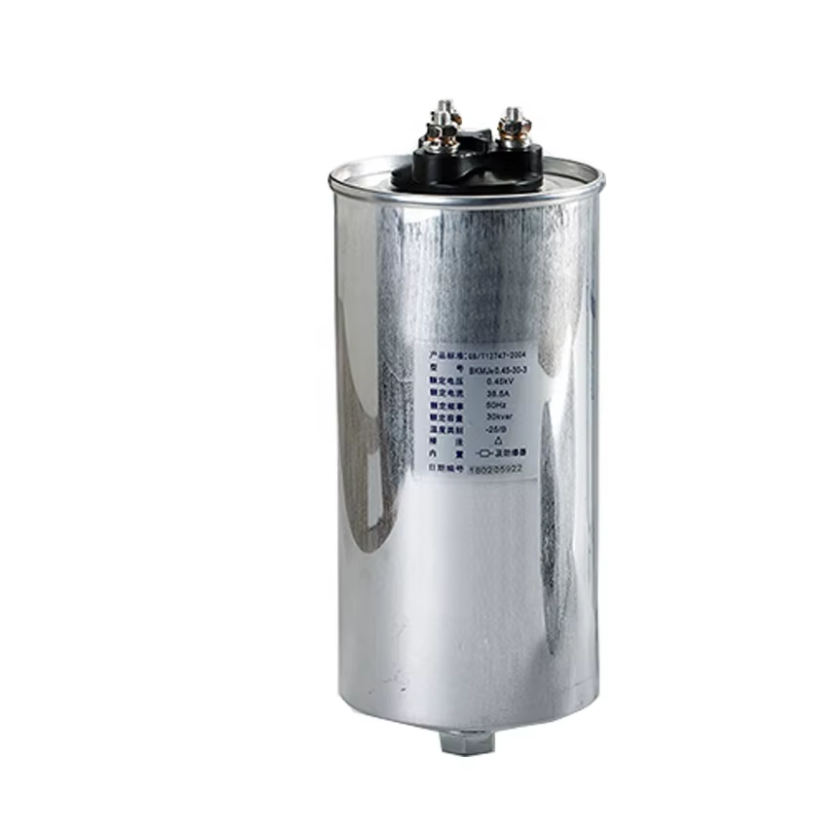
What are Self-healing Capacitor-cylindrical?
2026-05-21 15:41:07
Power quality problems can hurt your bottom line, whether you're in charge of a data center's uptime, making sure the grid stays stable for thousands of users, or building electrical systems with little time to spare. The parts you choose are very important. Self-healing Capacitor-cylindrical units are a tried-and-true way to deal with stability issues. These specific passive parts are made with metallized polypropylene film (MKP) as an insulator and come in a cylinder-shaped aluminum or flame-resistant plastic case. They are mainly made for correcting power factors, using AC motors, and filters in harsh industrial settings. The unique "self-healing" feature fixes small dielectric faults by vaporizing the thin metallized electrode layer around breakdown points. This restores insulation within microseconds without stopping the system, which gets rid of the catastrophic failures that normally happen with capacitors.
 |
 |
Understanding Self-Healing Cylindrical Capacitors
It's not just about looks; the cylinder shape is useful. This self-healing capacitor, cylindrical shape, directly solves the problems that rectangular box designs have with managing heat in high-density setups. The surface-to-volume ratio helps heat escape, which is very important when capacitor banks are used constantly in factories or power plants. Uniform internal pressure distribution stops hotspots from forming.
The Core Self-Healing Mechanism
The magic takes place very near the top. When voltage stress causes a localized dielectric breakdown, the energy immediately burns off the zinc-aluminum layer that surrounds the fault. Within milliseconds, this forms a protective layer that keeps the damaged part from affecting the rest of the capacitor, which keeps working properly. Over time, repeated healing events lower capacitance as tiny electrode areas disappear. However, modern designs can handle thousands of healing cycles before they hit the normal 5% capacitance loss level, which means the end of life. Dependability's value changes now that things can fix themselves. When the insulator in a traditional capacitor breaks down, it creates lasting short circuits. This means that the capacitor needs to be replaced right away, and other equipment that is tied to it could also fail. The self-healing method increases the operating lifespan beyond 100,000 hours under rated conditions. This greatly lowers the need for upkeep and the costs of unplanned downtime.
Critical Specifications Decoded
To make procurement choices, you need to know the key factors that affect how well an application fits the needs. Rated voltage tells you the highest steady AC voltage that the capacitor can safely handle. For example, equipment that works with 380V systems usually has 400V-rated capacitors to protect it against changes in the power grid. Standard low-voltage products have voltage values between 250V and 525V, and for medium-voltage uses, there are special units that can hit 2000V. Capacitance range, which is usually 5% to +10% according to IEC 60831 standards, shows how precisely the product was made and how much it can shift over time. For optimal performance, the dissipation factor (which measures internal losses) should stay below 0.2W/kvar. When compared to older capacitor technologies, lower numbers directly mean less heat production and wasted energy. This makes the system up to 30% more efficient overall.
Comparing Cylindrical Self-Healing Capacitors with Alternatives
Selecting the optimal capacitor type requires balancing multiple performance factors against application requirements and budget realities. While various capacitor technologies serve power electronics needs, each brings distinct advantages and limitations. Self-healing Capacitor-cylindrical variants deliver superior value in industrial power applications where reliability directly affects production output and income.
Performance Against Standard Capacitors
Standard non-self-healing film capacitors cost less initially but carry higher lifecycle expenses. A single dielectric failure triggers complete unit replacement, while self-healing variants continue operating through thousands of minor fault events. In applications experiencing frequent voltage transients—such as motor drives or renewable energy inverters—this resilience difference becomes economically decisive. This heat-saving feature is very important in small switchgear setups where limited wind makes cooling hard.
Ceramic and Electrolytic Alternatives
Ceramic capacitors are great at blocking high frequencies, but they don't have the capacitance density needed to fix the power factor at 50/60Hz. Electrolytic capacitors have a high capacitance in a small size, but they are sensitive to polarity, can't handle high AC voltages, and have shorter lifespans when they are stressed by ripple current. Neither technology has the ability to fix itself, which would allow for gradual failure instead of sudden failure. Total ownership costs must be taken into account in a cost-effectiveness study. Ceramic and electrolytic choices have lower unit costs, but they need to be replaced more often, which costs money and causes downtime.
Selecting the Right Self-Healing Cylindrical Capacitor for Your Needs
Strategic component selection takes into account electricity requirements, the climate, and the supply chain to get the best performance and the most efficient purchase. The Self-healing Capacitor-cylindrical selection process balances electrical specifications with long-term operational stability.
Voltage Rating Evaluation
The starting point for choosing is the operating power. When connecting equipment to 380V three-phase systems, it needs capacitors with a rating of at least 400V. This gives enough safety for normal grid swings. Uprated 480V or 525V units that can handle high RMS voltages without premature aging are better for places where harmonic distortion is high (above 15% total). When using the 400V Self-healing Capacitor-cylindrical BKMJ0.46-30-3, you can see how to choose the right voltage for common industry uses. Its 400V rate works with 380V systems and normal voltage changes, and its higher values up to 2000V are for specific medium-voltage applications. Frequency agreement at 50/60Hz makes world operation possible on a range of grid standards.
Environmental and Mechanical Requirements
The operating setting has a big effect on how long a component lasts. Temperature rates usually cover -40°C to +70°C. However, every 7°C rise above the rating temperature cuts the expected lifespan in half because the dielectric breaks down faster. Grounding bolts that are already attached make sure that electrical installations are safe and make it easier to connect to low-voltage distribution systems. Vibration resistance matters in mobile equipment and locations near heavy machinery, where cylindrical units handle mechanical stress better than box-type alternatives.
Manufacturer Differentiation
Differences in quality between providers have a big effect on long-term dependability and performance stability. Leading companies spend a lot of money on cutting-edge material science, high-precision manufacturing tools, and strict quality control procedures. Xi'an Xikai Medium & Low Voltage Electric Co., Ltd. has been making capacitors for more than 20 years and has gotten better at it through projects that need to be very reliable. Our factories are audited for ISO 9001 and ISO 14001 certification. Before being sent out, every capacitor goes through 72-hour load cycling tests, impulse voltage checks, and thermal shock trials. Xi'an Xikai can customize capacitance values and housing changes to meet the needs of environments with different levels of dust and humidity, such as those in the Middle East and Southeast Asia.
Practical Procurement Guide for B2B Clients
To get the best overall deal on purchases while still meeting all the requirements, smart sourcing plans balance things like part quality, price, delivery times, and the dependability of the provider. Procuring Self-healing Capacitor-cylindrical units requires a detailed evaluation of both technical specifications and supplier capabilities.
Supplier Evaluation Criteria
Checking out possible providers stops problems with quality and supply disruptions further down the line. Verification of certifications is the first step. Trustworthy makers easily give out ISO 9001 quality management documents, IEC 60831 capacitor standard compliance certificates, and CCC safety marks for goods made in China. How reliable deliveries are is affected by how much can be made. Suppliers who run specialized production lines with automatic wrapping equipment always keep their delivery promises. Xi'an Xikai keeps up its production capacity to handle large orders in four weeks, ensuring supply continuity even when the market is down.
Pricing and Terms Negotiation
Commitments to buy in bulk let you get better prices. Manufacturer discounts are justified by annual purchase deals or project-based large orders. Volume breaks usually happen at 100, 500, and 1,000 units or more, where savings reach 15 to 25 percent. Total purchase costs are affected by payment and shipping terms. With ex-works prices, sellers are responsible for delivery, while DDP (Delivered Duty Paid) terms simplify international procurement by bundling transportation and customs clearance. The 10-year guarantee on Xi'an Xikai capacitors shows confidence in long-term dependability and lowers replacement risks.
Future Trends and Innovations in Self-Healing Capacitor Technology
The development of technology keeps making capacitors, work better and giving us new ways to use them. Staying informed on emerging developments in Self-healing Capacitor-cylindrical technology supports strategic procurement decisions.
Material Science Advancements
The breaking strength and temperature stability of next-generation dielectric films are said to be better. Nano-composite materials with ceramic particles mixed in with polymer structures raise the dielectric constant while keeping their self-healing qualities. The electrode metallization study focuses on improving healing behavior through segmented electrode designs and graded thickness metallization. These advances balance current-carrying capability with healing efficiency, extending usable life before capacitance loss reaches replacement thresholds.
Application Domain Expansion
Electric vehicle adoption drives demand for robust DC-link and filtering capacitors handling rapid charge-discharge cycles and wide temperature swings. Similarly, renewable energy integration—particularly solar inverters and wind turbine converters—creates growing markets for capacitors managing harmonic-rich environments. Smart grid development introduces sophisticated monitoring requirements, where future designs may incorporate embedded sensors reporting real-time capacitance, temperature, and cumulative healing events to enable predictive maintenance strategies.
Supply Chain Considerations
Geopolitical factors and environmental regulations reshape capacitor supply chains. Manufacturers investing in sustainable production processes gain preference as corporate sustainability commitments mature. Xi'an Xikai's ISO 14001-certified production facilities minimize environmental footprint while ensuring regulatory compliance. Diversified sourcing strategies, including maintaining strategic inventory in key markets and local technical support, improve responsiveness during urgent replacement needs or project acceleration requirements.
Conclusion
Selecting Self-healing Capacitor-cylindrical components requires balancing electrical specifications, environmental conditions, quality standards, and supply chain reliability. The self-healing mechanism delivers transformative reliability benefits—automatically repairing minor faults to prevent catastrophic failures and extend operational lifespans beyond 100,000 hours. Cylindrical form factors provide thermal management advantages and mechanical robustness essential for demanding industrial applications. As capacitor technology advances through improved materials and smart monitoring capabilities, partnering with experienced manufacturers ensures access to innovations delivering competitive advantages through enhanced equipment reliability and operational efficiency.

FAQ
1. What distinguishes self-healing capacitors from conventional film capacitors?
The Self-healing Capacitor-cylindrical mechanism automatically repairs dielectric breakdowns by vaporizing metallized electrode material around fault points, restoring insulation within microseconds. Conventional capacitors experience permanent short circuits requiring immediate replacement when dielectric failures occur. This difference dramatically extends operational lifespan and prevents cascading failures in connected equipment.
2. How does the cylindrical form factor benefit power correction applications?
Cylindrical geometry provides uniform internal pressure distribution and superior thermal dissipation compared to rectangular designs. The enhanced surface-to-volume ratio improves heat transfer in high-density capacitor banks where airflow limitations challenge cooling. Mechanical robustness from threaded stud mounting withstands vibration better than box-type alternatives with snap-fit or adhesive assembly.
3. What voltage rating should procurement managers specify for 380V systems?
Equipment operating on 380V three-phase systems requires 400V-rated capacitors minimum, providing a safety margin for normal grid voltage fluctuations. Environments with significant harmonic distortion exceeding 15% THD benefit from uprated 480V or 525V units that handle elevated RMS voltages without accelerated aging. The voltage safety factor prevents premature failure while maintaining reliable power factor correction.
Partner with Xi'an Xikai for Superior Self-Healing Capacitor-cylindrical Solutions
Xi'an Xikai Medium & Low Voltage Electric Co., Ltd. stands as a trusted Self-healing Capacitor-cylindrical manufacturer serving industrial facilities, utility operators, and EPC firms across North America and beyond. Our BKMJ0.46-30-3 series and extensive product portfolio deliver proven reliability backed by over 20 years of engineering expertise and multiple patented technologies. We provide customized solutions addressing unique environmental challenges—from dust-heavy desert installations to high-humidity coastal facilities—ensuring optimal performance in your specific operating conditions. Connect with our technical team at serina@xaxd-electric.com, amber@xaxd-electric.com, or luna@xaxd-electric.com for detailed datasheets, application engineering support, and competitive bulk pricing on self-healing capacitor-cylindrical units.

References
1. "Power Factor Correction in Industrial Systems: A Technical Guide," International Electrotechnical Commission Technical Report IEC/TR 60831-3, 2019.
2. Zhang, M., and Roberts, J., "Self-Healing Mechanisms in Metallized Film Capacitors: Material Science and Reliability Analysis," IEEE Transactions on Dielectrics and Electrical Insulation, Vol. 26, No. 4, 2019.
3. "Capacitor Selection Guide for Power Electronics Applications," Institute of Electrical and Electronics Engineers Industry Applications Society, 2021.
4. Williams, P., "Thermal Management in High-Density Capacitor Banks: Form Factor Impact on Reliability," Power Quality Engineering Journal, Vol. 15, No. 2, 2020.
5/ "Low Voltage Switchgear and Controlgear Assemblies—Part 7: Assemblies for Specific Applications Such as Marinas, Camping Sites, Market Squares, Electric Vehicles Charging Stations," IEC 61439-7 Standard, 2022.
6. Chen, L., and Anderson, K., "Lifecycle Cost Analysis of Capacitor Technologies in Industrial Power Systems," Journal of Electrical Equipment and Systems Management, Vol. 8, No. 3, 2021.