How to reduce electricity bills and avoid penalties with power factor correction
2026-05-26 15:59:26
Increasing energy prices and fines from the utility company can have a big effect on your business's bottom line. The answer is to strategically put in place Power Factor Correction Capacitor systems that make the best use of reactive power. Industrial sites can cut down on lost energy, lower demand charges, and avoid expensive fines from utility companies by improving power factor, which is the ratio between actual power and visible power. Modern correction capacitors balance out the reactive component made by magnetic loads like motors and transformers. This brings your system closer to a unity power factor and saves you money right away.
 |
 |
Understanding Power Factor and Its Role in Electricity Billing
Power factor shows how well your electricity system turns the power that comes in into work that can be done. When magnetic equipment works, it changes the phase of the voltage and current. This makes reactive power, which doesn't do any work but still runs through your distribution network. Utilities keep a close eye on this wasteful behavior because reactive power raises transmission losses and needs more infrastructure space.
What Power Factor Means for Your Operating Costs
There are demand costs based on kilovolt-amperes (kVA) rather than just kilowatt-hours (kWh) in most business and industrial energy rates in the US. When your power factor is low, usually less than 0.95, it means you're taking more power than you need to do the same amount of work. When your power factor goes below a certain level, usually between 0.90 and 0.95, based on local rules and your service deal, utility companies charge you a fee.
Industry Benchmarks and Regulatory Requirements
To keep critical technology and medical equipment running smoothly, data centers and hospitals usually aim for power factors between 0.95 and 0.98. When factories have a lot of motors, it can be hard to keep even 0.85 without adjustment devices. State Grid rules and utility policies are different, but most business users have to deal with penalties that get worse as they fall below certain levels. If you know how your energy charges are structured, you can figure out how much money you will save by strategically deploying capacitors to improve your power factor.
How Power Factor Correction Capacitors Work to Reduce Costs
Power Factor Correction Capacitor systems make leading reactive power, which is the opposite of what inductive loads do, which is trailing reactive power. This adjustment effect lowers the total reactive current coming from the utility. This makes it look like you need less power, but your equipment still gets the same amount of active power. This fix is based on the idea that capacitive reactance cancels out inductive reactance. This makes the current waveform more in phase with the voltage waveform.
Electrical Principles Behind Capacitive Compensation
There is a delayed power factor when AC current runs through an inductor because the magnetic field saves energy between cycles. A leading power factor is made when capacitors store energy in an electric field with the opposite phase relationship. By putting in capacitors of the right size near inductive loads, you can balance these reactive parts inside your building instead of sending reactive current across the utility meter. This local replacement lowers the amount of current going through your distribution system. This lowers resistance losses and frees up space in transformers, wires, and switches.
Automatic Versus Fixed Correction Systems
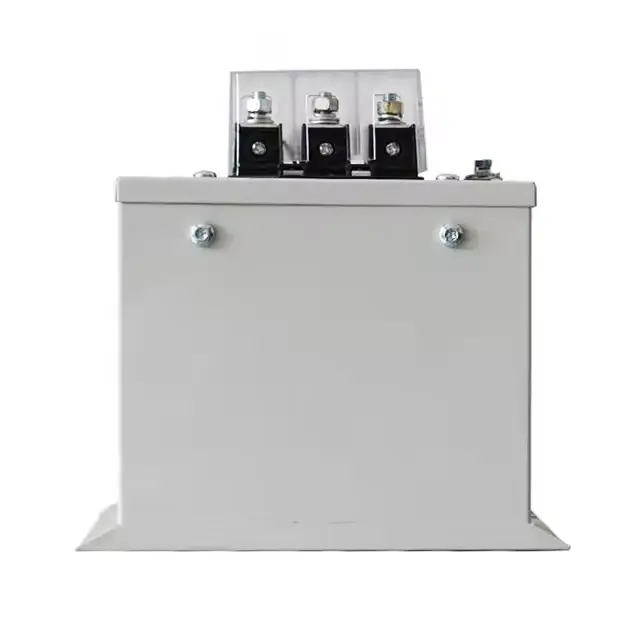
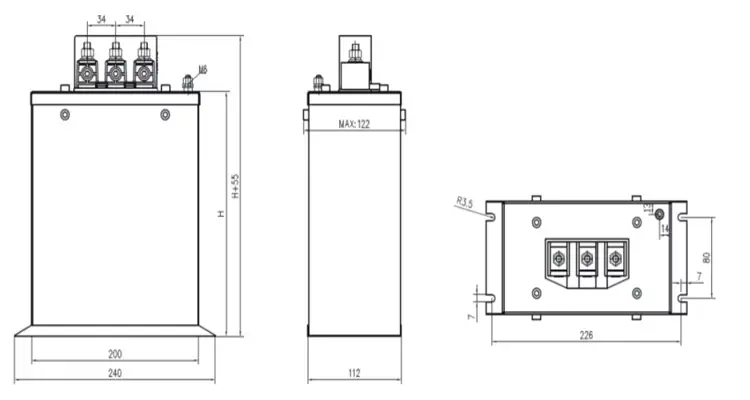
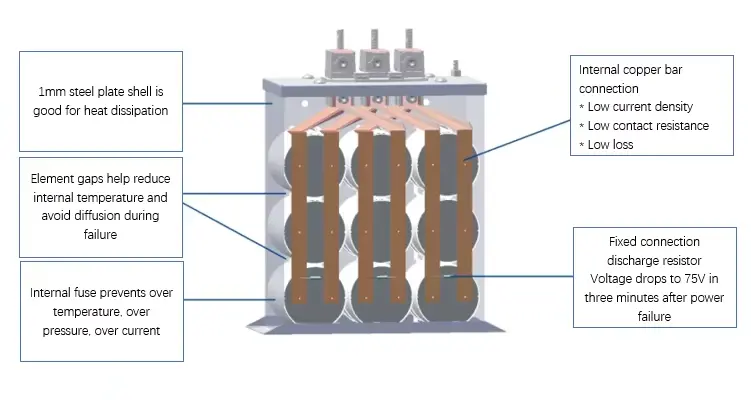
Fixed capacitor banks offer steady reactive power correction, which makes them perfect for buildings with steady, regular loads. You put in capacitors directly at the motor connections or distribution panels. The capacitors should be the right size for the reaction demand. Automatic power factor correction (APFC) systems use smart controls and contactors to turn capacitor stages on and off based on readings of the power factor taken in real time. This dynamic reaction works well for places where the load changes, like factories where production lines turn on and off during shifts. The Xi'an Xikai 50KVAR capacitor has a number of different connection types and connector choices, such as D, Y, YN, III, and M6, M8, and M10. This makes it suitable for both fixed and automatic setups at voltages ranging from 100V to 1000V.
Practical Steps to Implement Power Factor Correction Successfully
For a repair system to work, it needs to be carefully planned out, with the right parts chosen and installed according to the rules. If you hurry through this process or don't figure out how many capacitors you need, you could end up with resonance conditions, unstable voltage, or equipment that breaks down too soon.
Conducting Load Analysis and Sizing Calculations
Start by doing full power quality checks with logging meters that are left in place for several weeks to record changes in load under different operating conditions. Look at how the demand for reactive power changes during times of high production, partial loads, and idle times. Use the formula kVAR = kW × (tan θ₁ - tan θ₂) to find the capacitive kVAR that you need. Here, θ₁ is the power factor angle you're starting with, and θ₂ is the power factor angle you want to reach. Take into account the levels of harmonic distortion, since high harmonic content calls for detuned reactor setups instead of normal systems with only capacitors.
Maintenance Protocols and Troubleshooting
Set up review times every three months to look for damage to the outside, strange noises, or a rise in temperature that could mean internal problems. Every year, check the capacitor numbers to find out if there is a slow loss of capacity that makes the fix less effective. Modern units like the Xi'an Xikai BKMJ series have self-healing technology that extends service life by fixing small problems automatically. However, over time, damage builds up and lowers output capacity. Watch how the power factor changes at your utility meter. If it slowly goes down even though the load hasn't changed, that means the capacitors need to be replaced. If you see voltage confusion or a capacitor burning, you need to take care of harmonic resonance problems right away. Resonance conditions can kill capacitors within days.
Evaluating and Selecting the Best Power Factor Correction Capacitors for Your Business
Instead of just comparing unit prices, strategic buying needs to look at technical performance, quality standards, partner skills, and the total cost of ownership.
Critical Technical Specifications to Verify
The voltage value of a Power Factor Correction Capacitor must be higher than the system's standard voltage by an amount big enough to handle overvoltage situations. The Xi'an Xikai 50KVAR unit's range of 100V to 1000V works for most low-voltage industrial uses. Make sure that the capacitance range (which is usually between -5% and +10%) matches up with your size figures. The temperature rating should be right for the place where it will be installed. The range of -25°C to 50°C is good for most industrial settings inside, but it might not be enough for substations outside or in harsh climates. Your electrical grid must be compatible with the frequency (50Hz or 60Hz). Using Power Factor Correction Capacitor units rated for the wrong frequency causes them to boil and fail early.
Evaluating Manufacturers and Supply Chain Reliability
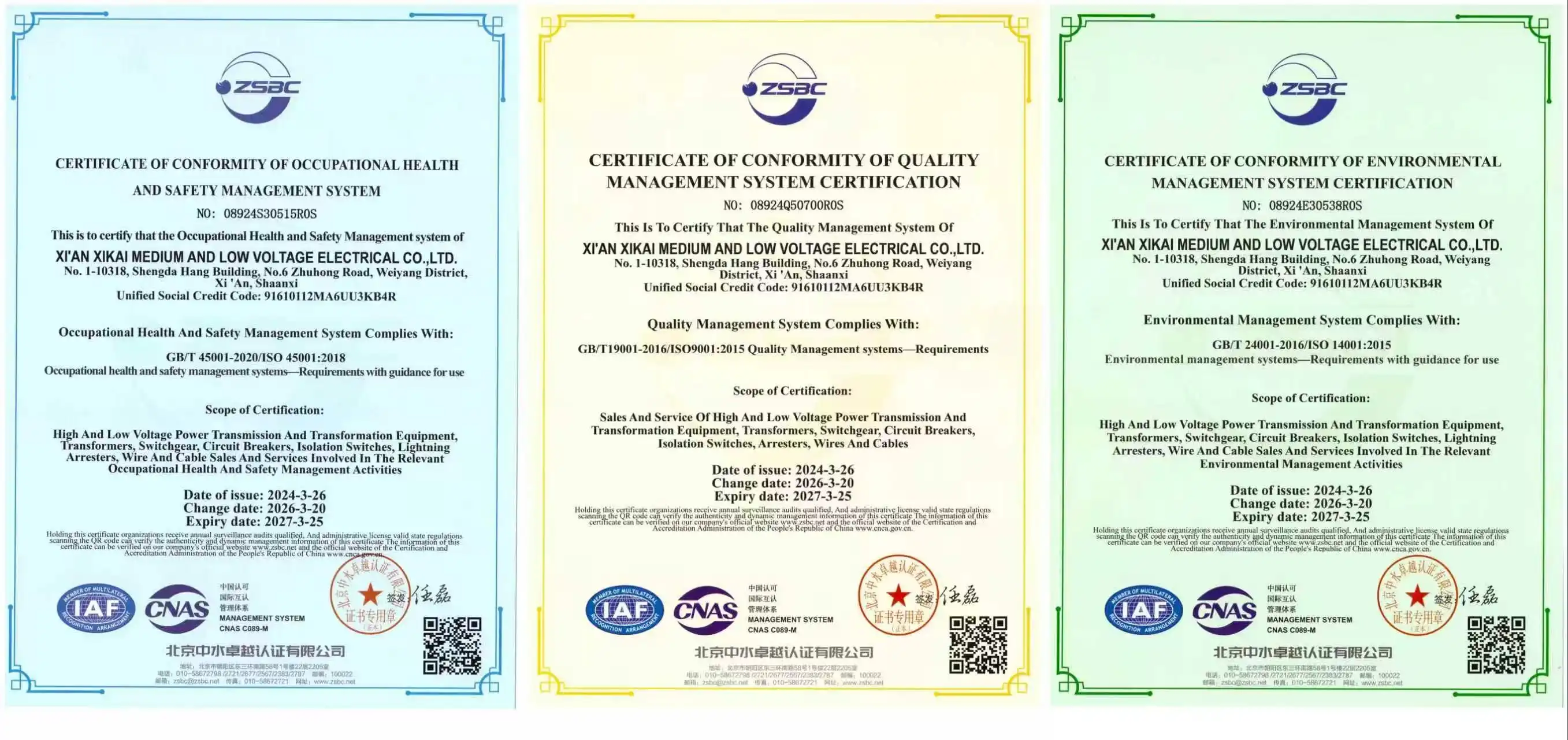
Manufacturers that have been around for a long time and have a lot of knowledge offer better expert help and more consistent products. Xi'an Xikai runs one of China's biggest factories that makes medium and low-voltage electrical equipment. It supplies State Grid systems, power engineering projects, steel and metalworking operations, petroleum plants, and rail transportation infrastructure. This wide range of applications shows that it works well in harsh industrial settings. Check to see if the providers can make changes to meet specific power needs, connector setups, or weather conditions. Check to see if there is local expert help and if the wait times are fair. Xi'an Xikai usually processes large orders within 4 to 6 weeks and includes full installation instructions and a guarantee.
Real-World Benefits: Case Studies and ROI of Power Factor Correction
The financial and practical benefits of strategic power factor growth can be seen in the numbers from real sites.
Manufacturing Plant Achieves 18% Demand Charge Reduction
A medium-sized company in the Midwest that makes car parts ran on a 0.82 power factor and had to pay a $4,200 penalty every month. During production shifts, load analysis showed that CNC cutting centers and robotic welders produced a lot of reaction power. The power factor went up to 0.96 after an automatic adjustment system with six steps of capacitor banks was put in place. All penalty charges were taken away, and peak demand was cut by 127 kVA. This cut monthly energy costs by $5,800. The total cost of the equipment was $38,500, and it was paid for in seven months. Less voltage drop across distributing lines and lower working temperatures in the main transformer were two more perks.
Data Center Enhances Capacity Without Infrastructure Upgrades
As the data center grew, the transformers' highest capacities were getting close. However, replacing the Power Factor Correction Capacitor then would take nine months and cost $280,000. A study of power quality found that computer power sources and HVAC systems caused a 0.88 power factor. By strategically placing correction capacitors near major distribution panels, the power factor was raised to 0.97, which freed up 285 kVA of visible power capacity. This freed up space so that 42 more computer racks could be added without having to change the transformers. This led to $1.4 million in yearly income growth. The $52,000 investment in the corrections system paid off right away while putting off major expenditures.
Sustainability and Regulatory Compliance Benefits
Not only does a better power factor save money, but it also cuts down on carbon emissions by lowering the total amount of energy lost in the delivery network. After making thorough corrections, a hospital campus saw a 12% drop in electricity system losses. This helped them meet their goals for green reporting and LEED approval. Facilities that take part in programs that reward energy saving can often get utility refunds that cover 20 to 40 percent of the costs of their repair systems. As businesses have to deal with stricter power quality standards, it becomes easier to follow the rules. Correction systems provide proof of responsible energy management for environmental audits and company sustainability reports.
Conclusion
When Power Factor Correction Capacitor systems are strategically put in place, energy costs go down, and utility penalties that hurt profits are eliminated. The best results are achieved by understanding the basics of power factor, choosing the right tools for repair, and following a set of steps for application. Xi'an Xikai's 50KVAR Self-healing Capacitor is a safe way to balance reactive power. It has self-healing technology, a strong build, and a number of setup choices that make it useful for a wide range of industrial uses. Full load analysis, correct size estimates, and following installation standards make repair work better and equipment last longer. Real-life case studies show that payback times are usually between six and eighteen months. There are also ongoing operating benefits, such as higher equipment capacity, more stable power, and lower system losses, which help with both financial and environmental goals.
FAQ
1. How often should we inspect and replace correction capacitors?
Visual checks every three months to look for damage, burning, or strange noises can help find problems before they get worse. Testing electrical systems once a year to find out their capacitance values and dissipation factors can find signs of wear and tear before they break. Self-healing capacitors usually last between 10 and 15 years in well-designed systems. However, they may only last 7 to 10 years in tough settings with a lot of switches or high harmonics. Replace units that have lost more than 10% of their capacity or have waste factors that are higher than what the maker recommends.
2. Can we retrofit capacitors into our existing electrical systems?
Most setups can be retrofitted as long as there is enough room in the distribution panels and the switches can handle the capacitor inrush currents. Power quality analysis can be used to check the current harmonic levels. Systems with total harmonic distortion above 5% need detuned reactor configurations instead of capacitor-only setups. Check that the safety devices work properly with the extra capacitor banks and that the voltage rises within acceptable limits when there is a small load.
3. What are typical lead times for industrial-grade capacitors?
Standard stock items from companies like Xi'an Xikai usually ship within 4 to 6 weeks for large orders, but there are faster choices for those who need them right away. It might take 8 to 10 weeks for custom setups that call for non-standard voltages, connection arrangements, or outdoor ratings. Getting in touch with dependable providers and keeping a smart stock of important extra parts can help keep delivery times to a minimum during system upgrades or sudden replacements.
Partner with Xi'an Xikai for Superior Power Factor Correction Solutions
Xi'an Xikai is ready to be your reliable source for Power Factor Correction Capacitors. They have a lot of experience with industrial, business, and utility uses. With its self-healing technology, exact capacitance limit, and long-lasting stainless steel construction, our 50KVAR Self-healing Capacitor performs exceptionally well in harsh conditions. Full expert help, the ability to make changes, and dependable delivery plans all make sure that projects are completed successfully. Email serina@xaxd-electric.com, amber@xaxd-electric.com, or luna@xaxd-electric.com to talk to our experienced team about your needs and get personalized suggestions.
References
1. Institute of Electrical and Electronics Engineers (IEEE). "IEEE Standard for Shunt Power Capacitors." IEEE Std 18-2012. New York: IEEE, 2012.
2. International Electrotechnical Commission (IEC). "Shunt Capacitors for AC Power Systems Having a Rated Voltage Above 1000V – Part 1: General." IEC 60871-1:2014. Geneva: IEC, 2014.
3. National Electrical Manufacturers Association (NEMA). "Shunt Power Capacitors." NEMA CP 1-2019. Rosslyn: NEMA, 2019.
4. Rodriguez, Jose and Pontt, Jorge. "Mitigation of Voltage Fluctuations and Power Factor Correction Using Energy Storage Systems in Industrial Facilities." IEEE Transactions on Industry Applications, Vol. 48, No. 6, 2012, pp. 2132-2142.
5. U.S. Department of Energy, Office of Energy Efficiency and Renewable Energy. "Improving Power Factor to Reduce Energy Demand Charges." Advanced Manufacturing Office Technical Brief. Washington: DOE, 2017.
6. Wagner, Vernon L. and Balda, Juan C. "Effects of Harmonics on Equipment and Power Factor Correction in Commercial Facilities." IEEE Transactions on Power Delivery, Vol. 28, No. 3, 2013, pp. 1789-1797.