Exploring Self-Healing Capacitors: Innovations and Applications
2026-05-22 16:05:37
Modern industrial processes rely on power quality, and system stability that don't go down. Self-healing Capacitor-cylindrical technology meets these important needs by fixing internal problems on its own, preventing the catastrophic breakdowns that often happen with other designs. These high-tech parts use metallized polypropylene film inside cylinder-shaped housings, which lets electrode melting automatically separate faults. This technology is now used in many fields, from data centers to green energy systems, to keep operations running smoothly, cut down on upkeep work, and get the best power factor adjustment. As the need for strong electrical infrastructure grows, building managers, power companies, and engineering firms must understand how self-healing works and what factors should be taken into account when buying things.
 |
 |
Understanding Self-Healing Cylindrical Capacitors
What Defines Self-Healing Technology
Self-healing Capacitor-cylindrical units represent a fundamental advancement in passive component design. In contrast to regular capacitors, which stop working forever when the dielectric breaks down, these devices have very thin metal layers that evaporate right away around problem areas. When voltage stress leads to localized breakdown, an arc forms that produces temperatures above 5000°C, quickly melting the zinc-aluminum electrode material around it. This makes a shielding gap that keeps the flaw from affecting the other electrode surface, which keeps working normally. It is clear that cylinder shapes are better at keeping heat in than rectangular shapes. The flame-retardant or metal casing spreads heat evenly, so there are no hot spots that speed up aging.
Precision-wound polypropylene film layers with graduated metallization thickness make up the inside. The edges get stronger coats to handle surge currents up to 200 times the maximum capacity, while the middle parts improve the insulating qualities. As an extra safety measure, a pressure-sensitive disconnector breaks the circuit links literally if internal gas buildup shows that the self-healing process is going too fast. These design features directly solve problems that building managers have with how things work. When the power factor falls below 0.95, utilities charge manufacturing plants that use inductive motor loads more for reactive power. Standard film capacitors need to be replaced too soon after repeated stress events, but Self-healing Capacitor-cylindricals keep their reactive compensation fixed even when the voltage changes quickly. It's especially helpful for hospitals and data centers to get rid of sudden component breakdowns that could damage sensitive equipment during surgery or while the cloud server is running.
Lifespan and Reliability Factors
Component longevity in industrial environments depends on managing multiple stress variables simultaneously. Self-healing Capacitor-cylindrical technology stops the chain of failures that usually happen in traditional designs, so the device can work for more than 100,000 hours under normal conditions. Each healing event uses up a very small amount of electrode area—about 0.01% per event. This means that devices can fix themselves thousands of times before the total capacitance loss hits the 5% end-of-life level set by IEC 60831 standards. The temperature has the most significant effect on decay rates. When the temperature rises by 7°C, the predicted lifespan is cut in half because the polymer chains in the dielectric film break down more quickly.
When reviewing specifications, this connection must be taken into account for installations in hot regions or near machines that generate heat. The effects of voltage stress are similar: running at 110% of the rated voltage all the time cuts life expectancy by 60%, so choosing the right margins during purchase is very important. Harmonic distortion is another aspect of stability that is often forgotten when a system is first designed. Modern power sources and variable frequency drives add harmonic currents that raise the RMS temperature of capacitor elements. To keep the temperature stable, environments with total harmonic distortion above 15% need to do derating calculations or choose higher voltage-class units. When there is harmonic content, the metallized film structure naturally handles it better than foil electrodes because self-healing events clear out carbonized paths that would otherwise create partial discharge sites.
Innovations and Technologies Behind Self-Healing Cylindrical Capacitors
Material Science Breakthroughs
Recent developments in dielectric film manufacturing have elevated performance benchmarks significantly. Modern capacitors use polypropylene that is biaxially oriented and has a crystallinity level above 70%. This material has a breakdown strength of above 650V/μm and a dissipation factor below 0.0002 at working frequencies. This is 40% better than the materials that were available ten years ago, which directly means more energy efficiency and less closet room needs. Gradient coating processes are now used in electrode metallization methods. Edge-heavy patterns put down layers of 800-angstrom aluminum-zinc alloy near the edges of the film to protect them from inrush currents that happen during switching operations. In the middle, 300-angstrom coats are used to make the capacitive energy storage work best.
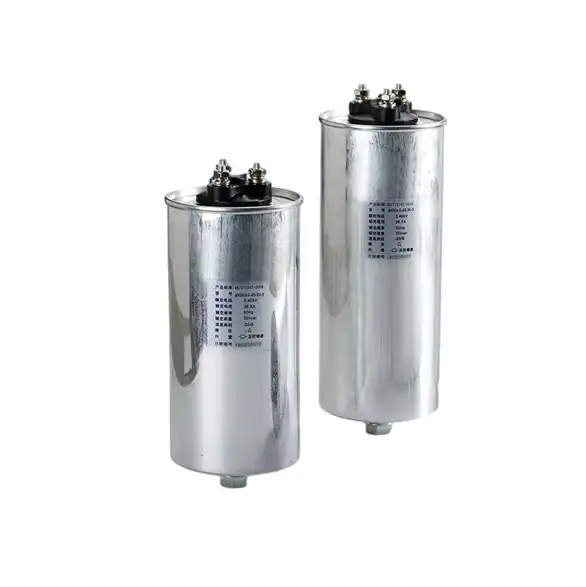
This design method stops edge-burning problems that used to happen a lot in high-current tasks like starting motors. Mineral oil and tar mixtures are no longer used as potting materials. Instead, polyurethane glue systems are used. The 400V Self-healing Capacitor-cylindrical BKMJ0.46-30-3 uses soft PU resin that hardens into a bendable structure that absorbs shocks and keeps wetness out. This formula gets IP54 environmental protection ratings without the leaking risks that come with liquid dielectrics. This means that it can be installed in any direction, which is a huge benefit for upgrading existing capacitor banks in switchgear that doesn't have a lot of room.
Performance Advantages Over Traditional Designs
Comparing Self-healing Capacitor-cylindrical units against non-regenerative alternatives reveals substantial operational differences. When the insulator in a standard film capacitor fails, it immediately short-circuits, which sets off safety devices that take out whole banks of capacitors from service. When reactive support is suddenly lost, voltage drops across linked loads. This can damage motor windings or trip undervoltage switches. Self-healing Capacitor-cylindrical designs keep circuits intact by separating problems locally. This keeps the system stable during short-term events. Metrics for the energy economy also show measurable gains. The BKMJ0.46-30-3 has loss factors below 0.2W/kvar, which means that a 30kvar unit that runs constantly uses less than 6 watts of power inside.
Over a year of use, this energy benefit lowers the need for heat removal and increases the life of parts. Facilities that want to get LEED certification or meet the requirements for ISO 50001 energy management find that recorded drops in power loss help them meet their green reporting duties. To understand a datasheet, you need to know a few important things. Rated voltage (Un) shows how long the unit can work continuously. For example, a 400V unit works with 380V three-phase circuits and has enough room for short-term overvoltages. According to IEC guidelines, capacitance error usually ranges from 5% to +10%, which affects the accuracy of the reactive power supply. The highest allowable current (Imax) sets the temperature limit for settings with a lot of harmonics, while the equivalent series resistance (ESR) controls how ripple current is handled. Managers of procurement should check that surge current values are higher than 100²A to handle close inrush without having to use a disconnector that is too noisy.
Applications and Benefits of Self-Healing Cylindrical Capacitors in Industry
Power Factor Correction in Manufacturing Facilities
CNC machining centers and automated assembly lines present demanding electrical loads characterized by lagging power factors between 0.65 and 0.80. This problem can be fixed by installing Self-healing Capacitor-cylindrical banks directly at motor control centers. This gets rid of the monthly energy fines that can be more than $5,000 for medium-sized plants. The circular shape makes it possible to put it vertically in existing switchgear spaces, which requires less installation work than bulky box-style options. In these settings, the ability to withstand surges is very important.
When the transformer turns on and the motor starts, voltage spikes that reach 2.5 times normal values in milliseconds happen. The metallized design of the BKMJ0.46-30-3 absorbs these transients through controlled self-healing, while ceramic dielectric capacitors would break under the same amount of stress. Case studies from companies that make parts for cars show that with Self-healing Capacitor-cylindrical units, the average time between failures goes from 18 months with normal capacitors to over 8 years. This means that repair costs are much lower and production stops less often.
Critical Infrastructure Reliability
Hospital electrical systems cannot tolerate component failures that disrupt surgical suites or imaging equipment. When Self-healing Capacitor-cylindricals are put into automatic power factor correction panels, the panels work without any problems. This means that facilities management teams never get failure alarms that need to be repaired during off-hours. The flame-retardant casing meets NFPA 70 fire code requirements, while silent operation below 45dB eliminates the audible hum that disturbs patient care areas. Data centers pursuing five-nines uptime commitments (99.999% availability) incorporate these components into uninterruptible power supply systems and precision air conditioning units.
The maintenance-free characteristic aligns with predictive maintenance philosophies, as capacitors retain functionality throughout planned 10-year refresh cycles. Financial institutions operating trading floors have documented improved system availability metrics after specifying self-healing technology, as power quality disturbances no longer propagate through distribution networks. These applications demonstrate quantifiable advantages. Environmental benefits accrue through extended component lifecycles that reduce electronic waste streams and decrease embodied carbon from manufacturing replacement units.
How to Choose the Best Self-Healing Cylindrical Capacitor for Your Business
Technical Specification Matching
Procurement decisions for a Self-healing Capacitor-cylindrical begin with accurate load characterization. Voltage rating selection must accommodate continuous overvoltage—systems with weak grid connections experiencing variation require higher-rated units to prevent premature aging. Environmental considerations influence enclosure selection, ensuring the unit withstands ambient temperatures and mechanical stress unique to the installation site.
Supplier Evaluation Criteria
After-sales support structures warrant careful assessment. Suppliers offering technical consultation during specification review prevent costly misapplication—incorrectly sized capacitors cause nuisance fuse operations or insufficient power factor correction. Warranty terms extending beyond standard one-year coverage indicate manufacturer confidence in product longevity. Procurement teams should verify that minimum order quantities align with project scale, as some manufacturers require 50-unit minimums that exceed requirements for smaller installations.
Lead time predictability affects project scheduling. Standard voltage ratings typically ship within 4 weeks, while custom specifications requiring modified capacitance values or specialized terminations extend to 8-12 weeks. Establishing framework agreements with qualified suppliers ensures component availability during planned maintenance windows, avoiding rush orders that inflate costs. Pricing transparency matters—request detailed quotations separating material costs, tooling charges for custom enclosures, and logistics expenses to enable accurate budget forecasting.
Future Trends and Market Outlook for Self-Healing Cylindrical Capacitors
Emerging Technology Integration
Industry 4.0 initiatives drive demand for smart systems incorporating embedded sensors and wireless communication. Prototypes now monitor internal temperature, accumulated healing events, and capacitance drift, transmitting data to supervisory control systems via industrial IoT protocols. This connectivity enables predictive maintenance strategies—facility managers receive advance warning when components approach end-of-life thresholds, scheduling replacements during planned downtime rather than reacting to sudden failures.
Material science research explores graphene-enhanced dielectrics promising 50% higher energy density within identical physical envelopes. Laboratory results demonstrate breakdown strengths exceeding 900V/μm while maintaining self-healing characteristics, potentially enabling 630V-rated capacitors in current 400V package sizes. Such advancements would reduce cabinet space requirements by 35%, valuable for retrofitting aging substations with limited expansion room.
Market Dynamics and Sourcing Strategies
Global capacity expansion accelerates in response to renewable energy growth. Solar inverter manufacturers alone consumed 18 million Self-healing Capacitor-cylindrical units in 2023, projected to reach 32 million annually by 2027 as grid-scale battery storage installations proliferate. This demand surge tightens supply chains for specialized dielectric films, prompting procurement professionals to secure long-term supply agreements locking in favorable pricing. Geopolitical considerations influence sourcing decisions.
Trade policies affecting component imports necessitate supplier diversification strategies—maintaining relationships with manufacturers across multiple regions mitigates disruption risks from tariff changes or logistics interruptions. Facilities requiring domestic content compliance for government contracts should verify country-of-origin certifications and manufacturing location documentation. Strategic recommendations for procurement teams include establishing preferred supplier partnerships, emphasizing quality consistency over lowest unit cost. Evaluate total value proposition encompassing technical support, inventory management services, and collaborative product development for application-specific requirements. Participate in industry technical committees shaping future standards—early awareness of specification changes allows proactive qualification of compliant components before regulatory mandates create supply constraints.
Conclusion
Self-healing Capacitor-cylindrical technology fundamentally improves electrical system resilience through automatic fault recovery, extended operational lifespans, and maintenance-free performance. The innovations detailed throughout this exploration—from advanced metallized films to intelligent monitoring capabilities—address critical pain points facing industrial operators, utility providers, and engineering firms. Strategic procurement decisions balancing technical requirements with supplier capabilities position organizations to capitalize on efficiency improvements and reliability gains. As renewable energy integration and industrial automation intensify electrical demands, self-healing Capacitor-cylinders emerge as essential infrastructure components supporting operational continuity and sustainability objectives.
FAQ
1. What differentiates Self-healing Capacitor-cylindricals from standard film capacitors?
Self-healing designs incorporate metallized electrodes that vaporize around fault locations, isolating defects and maintaining circuit operation. Standard film capacitors with foil electrodes experience permanent short circuits upon dielectric breakdown, requiring immediate replacement. This fundamental difference translates to substantially longer service life and reduced maintenance requirements in industrial applications.
2. Can self-healing capacitors handle high-frequency applications?
Cylindrical configurations inherently possess low equivalent series inductance (ESL), making them suitable for filtering applications up to 10kHz switching frequencies common in renewable energy inverters. Performance degrades above 20kHz as skin effect and dielectric losses increase, requiring specialized ceramic or film technologies for higher-frequency power electronics.
3. How do I verify datasheet accuracy before bulk procurement?
Request sample units for independent testing, verifying claimed specifications. Measure capacitance at rated voltage using precision LCR meters, confirm dissipation factor under load conditions, and conduct accelerated life testing at elevated temperatures. Reputable suppliers willingly provide test samples and technical documentation supporting published ratings.
Partner with Xi'an Xikai for Self-Healing Capacitor Solutions
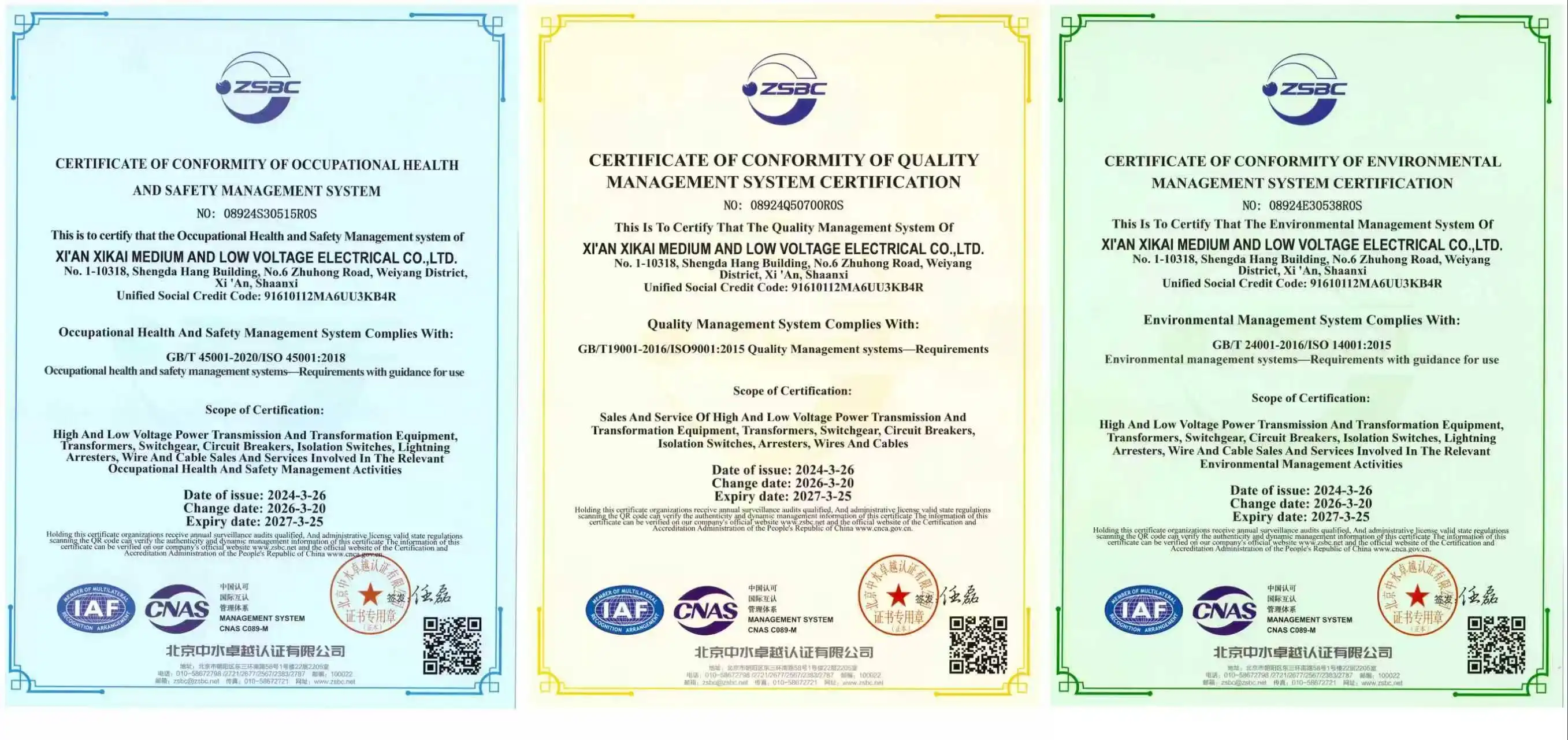
Xi'an Xikai Medium & Low Voltage Electric Co., Ltd. delivers comprehensive power factor correction solutions featuring the 400V Self-healing Capacitor-cylindrical BKMJ0.46-30-3 and complete system integration services. Our two decades of manufacturing expertise support installations across State Grid projects, renewable energy facilities, and industrial complexes requiring uncompromising reliability. Contact our engineering team at serina@xaxd-electric.com, amber@xaxd-electric.com, or luna@xaxd-electric.com to discuss project-specific requirements. We provide customized specifications meeting altitude, temperature, and harmonic conditions unique to your operations, backed by ISO 9001 quality systems and patented technologies.
References
1. IEEE Standard 18-2012: IEEE Standard for Shunt Power Capacitors, Institute of Electrical and Electronics Engineers, 2012.
2. IEC 60831-1:2014 Shunt Power Capacitors of the Self-Healing Type for AC Systems Having a Rated Voltage up to and Including 1000V, International Electrotechnical Commission, 2014.
3. Sarjeant, W.J., et al., "Capacitive Components for Power Electronics," Proceedings of the IEEE, Vol. 89, No. 6, 2001, pp. 846-855.
4. Ho, J., and Jow, T.R., "High Field Conduction in Biaxially Oriented Polypropylene at Elevated Temperature," IEEE Transactions on Dielectrics and Electrical Insulation, Vol. 19, No. 3, 2012, pp. 990-995.
5. Rabuffi, M., and Picci, G., "Status Quo and Future Prospects for Metallized Polypropylene Energy Storage Capacitors," IEEE Transactions on Plasma Science, Vol. 30, No. 5, 2002, pp. 1939-1942.
6. Makdessi, M., et al., "Metallized Polymer Film Capacitors Ageing Law Based on Capacitance Degradation," Microelectronics Reliability, Vol. 54, No. 9-10, 2014, pp. 1823-1827.