Indoor Disconnect Switch Applications in Homes and Businesses
2026-09-10 11:38:17
Indoor disconnect switches serve as a foundational safety layer in both residential and commercial electrical systems. Whether you are isolating a rooftop solar array for routine maintenance or shutting down high-voltage substation equipment during an emergency, the right isolation switch prevents energized-circuit accidents and keeps operations compliant. This guide covers how indoor disconnect switches work, where they are applied, how to select and procure them, and what installation and maintenance best practices apply — including insights on the GN2 High Voltage Disconnect Switch from Xi'an Xikai.

Understanding Indoor Disconnect Switches: Purpose and Functionality
Manual Isolation and Visible Break for Safety and Compliance
An indoor disconnect switch is a device that can be operated by hand or by electricity and breaks an electrical circuit in a way that can be seen and checked. A circuit breaker automatically turns off power when there is a fault, but a disconnect switch has to be pressed on purpose, for example to disconnect equipment for maintenance, to turn off power to a part of a power distribution network, or to allow emergency shutdowns. Article 430 of the National Electrical Code (NEC) says that motor-driven equipment must have a way to disconnect within sight of the motor. This usually means a properly rated isolation switch.
Types of Indoor Disconnect Switches
There are three main types of procurement specifications. Fusible disconnect switches are a small way to protect industrial motor circuits from overcurrent and separation. They do this by having built-in fuse elements. Non-fusible models offer a clean isolation point without fuse safety. They are often found in HVAC disconnects and solar combiner boxes, paired with upstream overcurrent devices. Quick-make/quick-break switches use a stored-energy mechanism that snaps contacts open or closed no matter how fast the operator is moving. This keeps the contacts from being exposed to arcs and increases their life. The first step in any buying choice is to figure out which type fits your load profile and safety needs.
Applications of Indoor Disconnect Switches in Homes and Businesses
The surroundings have a big effect on where an indoor disconnect switch goes and how much power it can handle. Most home installations use 120V to 240V and current rates of less than 200A. Commercial and industrial systems, on the other hand, can reach 40.5kV and 2000A. Engineers can choose the right voltage class, enclosure rating, and mechanical endurance by knowing what the application is for.
Residential Applications
A solar disconnect switch, usually a non-fusible 600V DC or AC type, needs to be placed between the generator and the utility meter for homeowners who want to install photovoltaic systems on their roofs. NEC 690.15 says that a solar system must have a way to separate all of its wires. In the same way, HVAC units need a designated disconnect that can be seen from the condenser unit. For home air conditioning, a 240V, 60A fusible indoor disconnect switch is required. The fuse protects the compressor from locked-rotor current, and the switch lets service technicians do their jobs safely without having to go back to the main panel.
Commercial and Industrial Applications
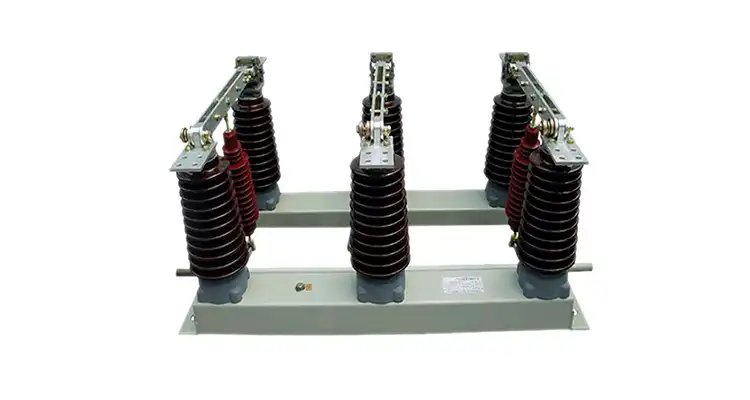
Electrical sub-panels, lighting circuits, and machinery feeds in commercial buildings are controlled by indoor disconnect switches. Quick-make/quick-break models are used in hospitals and data centers to keep arc energy to a minimum during scheduled repair times. In heavy industries like mining, metallurgy, and chemical processing, high-voltage isolation switches separate medium-voltage distribution feeders into separate sections. This level of use is exactly what the GN2 High Voltage Disconnect Switch from Xi'an Xikai is made for. It can handle 400A, 630A, 1000A, 1250A, and 2000A of current and is rated at 40.5kV. It can be used for substation bus isolation, feeder switching, and transformer safety in both new and old grid systems.
Choosing and Procuring the Best Indoor Disconnect Switch for Your Needs
When buying isolation switches, you have to find a balance between technical compliance, long-term stability, and the ease of the supply chain. In a substation upgrade where time is limited, making this choice too quickly often causes interface problems that cause outage windows to last much longer than planned.
Key Evaluation Criteria
With these as your guides, you can write specifications:
- Voltage and current rating alignment: The device must match or go beyond the system's maximum continuous current and voltage ratings. For medium-voltage substations, the GN2 covers 40.5kV and has five current tiers, which lets engineers be flexible without having to make special parts.
- Standards compliance: IEC 62271-102 sets rules for earthing and high-voltage AC disconnect switches around the world. The GN2 meets the requirements for IEC 62271-102, IEEE C37.32, CE, and RoHS, which means it is already ready for projects that need to be certified in more than one region.
- Integrated earthing switch: The GN2 has an integrated earthing switch that lets held charges discharge to earth while repair is being done. This gets rid of the need for a separate movable earthing device and cuts down on the time needed to prepare for an outage, which is especially helpful for EPC workers who have to work within tight shutdown windows.
- Through-wall mounting capability: Older substations don't always have the clearance spaces that new equipment needs. The GN2's through-wall mounting design makes it possible to place it in switchgear rooms with limited space without changing the existing concrete base or bolt pattern. This is a big plus for old-station retrofit projects because it makes the equipment more compatible.
Together, these criteria make both installation easier and maintenance easier over the course of the product's life. Taking care of them early in the procurement process keeps expensive changes to specifications from having to be made during installation on-site.
Quality Assurance Benchmarks
At Xi'an Xikai, every GN2 unit goes through contact loop resistance testing (with a goal of less than 50 μΩ), dielectric withstand testing at 85kV for one minute, and 10,000-cycle mechanical endurance trials. The factory is ISO 9001 certified, and before machining, a spectrometer checks the alloy's composition. These protocols are the same as the acceptance criteria in GB 1985 and IEC 62271-102. This gives procurement teams a record of the quality of project documentation that they can follow.
Installation, Safety, and Maintenance Guidelines
Before putting in an indoor disconnect switch, make sure that the mounting surface, wire clearances, and earthing connections all follow the steps in the manufacturer's installation instructions and the electrical code that applies. For medium-voltage equipment like the GN2, the earthing switch must be linked with the main blade so that the earthing switch cannot close while the main contacts are open to a live bus — a mechanical interlock that the GN2 includes as a standard feature.
Maintenance Schedule
Maintenance times should be based on both time and operational cycles. A useful schedule has the following:
- Annual visual inspection: Check the insulators of the indoor disconnect switch once a year for surface tracking or contamination, make sure the bolt pressure on current-carrying joints is correct, and look at the working mechanism for rust or deterioration of the lubricant.
- Every 100 operating cycles: Use a micro-ohmmeter to check the contact resistance every 100 times the circuit is turned on and off. If the reading on silver-faced contacts is more than 50 μΩ, it means that the springs are worn out or the contacts need to be cleaned.
- Every 5 years or after a fault event: You should do a full dielectric test and mechanical cycle count study every 5 years or after a fault event. Use OEM-sourced parts to replace worn-out parts and keep the type-test validity.
The self-lubricating bearings of the GN2 reduce the frequency of mechanical maintenance. Its modular design lets you replace individual parts without taking the whole switch assembly off the wall, which is useful in substations with limited access.
Future Trends in Indoor Disconnect Switch Technology
When IoT sensors are built into isolation circuits, maintenance models change from being based on calendars to being based on conditions. Optional GN2 versions that work with SCADA send real-time data on contact temperature and operation count, which lets repair be planned ahead of time before a failure happens. Adoption of Industry 4.0 by power companies is speeding up this trend. A study from 2023 by MarketsandMarkets says that the global smart switchgear market will grow at a compound annual rate of 7.2% through 2028, mainly because of programs to modernize the grid. When looking at indoor disconnect switch suppliers, procurement teams should make sure that the vendor's product line supports protocol-level integration (IEC 61850, Modbus) to avoid products becoming outdated too soon.

Conclusion
Indoor disconnect switches are an important part of safe electrical infrastructure, from home solar panels to 40.5kV power lines. To choose the correct isolation switch, you need to make sure that it matches the installation environment in terms of voltage class, current rating, certification standard, and physical compatibility. The GN2 High Voltage Disconnect Switch from Xi'an Xikai is a tried-and-true solution for EPC contractors who have to do retrofits on old substations while working with tight shutdown schedules. It can be mounted through walls, has built-in earthing, and has a mechanical lifespan of 10,000 cycles. If you think about quality and compatibility during the design stage, you can avoid costly delays during installation.
FAQ
1. What is the difference between an indoor disconnect switch and a circuit breaker?
When there is too much current or a fault, a circuit breaker is supposed to cut off the load current. An indoor disconnect switch is meant to be used on purpose and is not designed to stop problem current. Each device does something different, but together they do their job well. The breaker fixes problems, and the stop switch makes it safe to do repair work.
2. Can a high-voltage disconnect switch be installed in a space-constrained substation?
Yes, as long as the switch can be mounted through the wall or in a small space. The GN2 can be installed through the wall, which means it can be used in old substations with the same base bolt patterns without any structural changes.
3. What certifications should an indoor disconnect switch carry for international procurement?
IEC 62271-102 is the main worldwide standard for medium-voltage equipment. IEEE C37.32 is used for projects that follow the rules in North America. The CE and RoHS marks make sure that European rules are followed. All four are on the GN2.
Partner with Xi'an Xikai for Reliable Indoor Disconnect Switch Solutions
Xi'an Xikai brings over 15 patents in high-voltage switchgear and a proven record across State Grid systems, rail transportation, and renewable energy projects. The indoor disconnect switch GN2 model is available through our global distribution network with customizable ratings and fast delivery options — an ideal choice for time-sensitive substation retrofit projects. Connect with our engineering team today to request technical specifications or a project-specific quotation. Reach us at serina@xaxd-electric.com, amber@xaxd-electric.com, or luna@xaxd-electric.com, or visit xaxd-electric.com to explore our full portfolio of indoor disconnect switch products and substation solutions.

References
1. National Fire Protection Association. NFPA 70: National Electrical Code. 2023.
2. International Electrotechnical Commission. IEC 62271-102: High-Voltage Switchgear and Controlgear — AC Disconnectors and Earthing Switches. 2018.
3. Institute of Electrical and Electronics Engineers. IEEE C37.32: Standard for High-Voltage Switches. 2018.
4. MarketsandMarkets. Smart Switchgear Market — Global Forecast to 2028. 2023.
5. International Electrotechnical Commission. IEC 61850: Communication Networks and Systems for Power Utility Automation. 2020.
6. Schneider Electric. Electrical Installation Guide: Medium-Voltage Distribution. 2022.